Density Altitude, Air Density & Pressure Altitude
1. Density
Density is the mass per unit volume of a substance.
In atmospheric applications, density may be expressed as:
- g/m³
- kg/m³
- Percentage of standard surface density, also called relative density
Important ISA Value
- ISA Mean Sea Level density: 1225 g/m³
2. Relationship Between Pressure, Temperature and Density
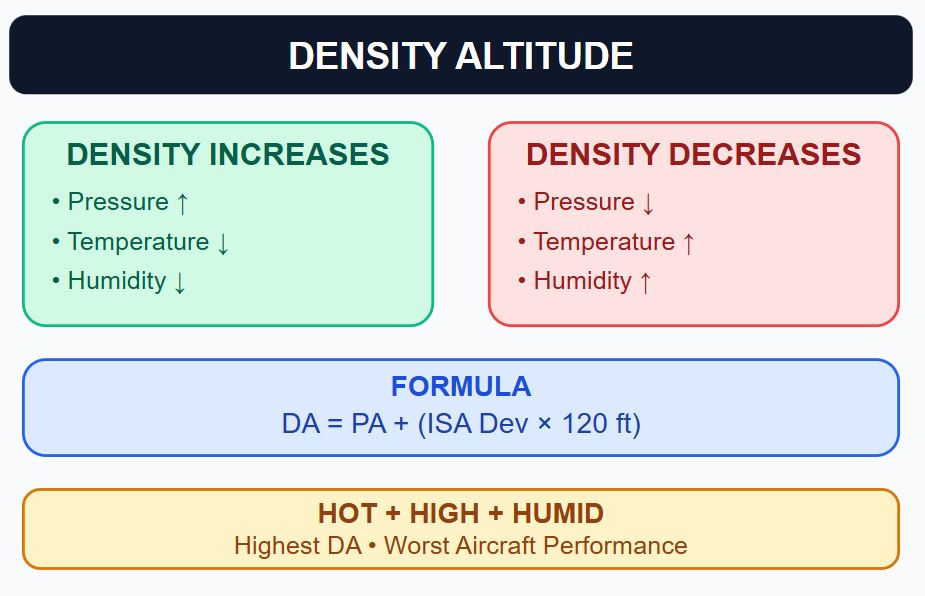
Air density is governed primarily by pressure and temperature, and is also affected by humidity.
The Gas Law relationship is:
ρ ∝ P/T
Where:
- ρ = air density
- P = pressure
- T = absolute temperature
Therefore:
| Change | Effect on Density |
|---|---|
| Pressure ↑ | Density ↑ |
| Pressure ↓ | Density ↓ |
| Temperature ↑ | Density ↓ |
| Temperature ↓ | Density ↑ |
| Humidity ↑ | Density ↓ |
| Humidity ↓ | Density ↑ |
Key Rule
Density is directly proportional to pressure and inversely proportional to temperature.
3. Effect of Humidity on Air Density
Moist air is less dense than dry air when pressure and temperature are the same.
The reason is that water vapour (H₂O) has a lower molecular mass than the main constituents of dry air:
- Nitrogen (N₂)
- Oxygen (O₂)
When water vapour is added to air, lighter H₂O molecules replace some of the heavier N₂ and O₂ molecules. This reduces the total mass per unit volume.
Important Points
- Higher water-vapour content → lower density
- Lower water-vapour content → higher density
- Water vapour has approximately 5/8 the density of dry air
- Moist air therefore produces a higher Density Altitude for the same pressure and temperature conditions.
4. Conditions Producing Low and High Air Density
Lowest Air Density
The lowest air density occurs with the combination of:
- Low pressure
- High temperature
- High humidity
This combination is particularly important at hot, high-altitude aerodromes.
Effect on Aircraft
Low air density results in:
- Reduced lift
- Reduced engine performance
- Reduced thrust
- Increased takeoff distance
- Increased landing distance/run
- Reduced climb performance
- Reduced maximum takeoff weight capability
Highest Air Density
The highest density occurs with:
- High pressure
- Low temperature
- Lower humidity
Quick Memory Rule
High pressure + cold air = high density
Low pressure + hot, humid air = low density
5. Pressure Altitude (PA)
Pressure Altitude is the altitude in the International Standard Atmosphere (ISA) at which the atmospheric pressure is equal to the pressure at the point in question.
In Simple Terms
Pressure Altitude represents the ISA altitude corresponding to the observed pressure.
6. Density Altitude (DA)
Density Altitude is the altitude in the International Standard Atmosphere (ISA) at which the observed air density exists.
It is essentially Pressure Altitude corrected for temperature deviation from ISA.
Density Altitude is important because aircraft and engine performance depend strongly on air density.
7. Pressure Altitude vs Density Altitude
| Condition | Density | Density Altitude |
|---|---|---|
| Warmer than ISA | Lower | Higher than PA |
| Colder than ISA | Higher | Lower than PA |
| Equal to ISA | Standard | DA = PA |
Most Important Rule
DA = PA only when OAT = ISA temperature.
8. Density Altitude Formula
The commonly used examination formula is:
DA = PA + (ISA Deviation × 120 ft)
Where:
ISA Deviation = OAT − ISA Temperature
Therefore, the complete procedure is:
- Determine the Pressure Altitude.
- Calculate the ISA temperature at that altitude.
- Calculate the ISA deviation.
- Multiply the deviation by 120 ft/°C.
- Add the correction to the Pressure Altitude.
9. Effect of Temperature on Density Altitude
If Temperature is Higher Than ISA
- ISA deviation is positive
- Density decreases
- Density Altitude increases
- DA > PA
- Aircraft performance decreases
If Temperature is Lower Than ISA
- ISA deviation is negative
- Density increases
- Density Altitude decreases
- DA < PA
- Aircraft performance improves
If Temperature Equals ISA
- ISA deviation = 0°C
- DA = PA
10. Density Altitude Correction Factor
For examination calculations:
1°C ISA deviation = approximately 120 ft change in Density Altitude
Therefore:
- +1°C → DA increases by 120 ft
- +5°C → DA increases by 600 ft
- +7°C → DA increases by 840 ft
- −1°C → DA decreases by 120 ft
- −4°C → DA decreases by 480 ft
Memory Rule
Warm → DA goes up
Cold → DA goes down
11. ISA Temperature
For common examination calculations below approximately 36,090 ft, use:
ISA temperature at MSL = +15°C
Approximate lapse rate:
2°C per 1,000 ft
Therefore:
ISA Temperature = 15°C − (2 × altitude in thousands of feet)
For example, at 12,000 ft:
ISA Temperature = 15 − (2 × 12)
= 15 − 24
= −9°C
12. ISA Temperature Above 36,090 ft
The source states that the ISA temperature decreases up to approximately:
36,090 ft / 11 km
Above this level, up to approximately:
65,617 ft / 20 km
the temperature remains approximately constant at:
−56.5°C
Therefore:
| Altitude | ISA Temperature |
|---|---|
| MSL | +15°C |
| Up to 36,090 ft | Decreases at approximately 2°C/1,000 ft |
| 36,090–65,617 ft | Approximately −56.5°C |
13. Step-by-Step Density Altitude Calculation
Example 1: PA = 12,000 ft, OAT = −12°C
Step 1: Find ISA Temperature
ISA lapse rate = 2°C/1,000 ft
ISA Temp = 15 − (2 × 12)
= −9°C
Step 2: Find ISA Deviation
ISA Deviation = OAT − ISA Temp
= −12 − (−9)
= −3°C
The air is 3°C colder than ISA.
Step 3: Calculate DA
DA = PA + (ISA deviation × 120)
= 12,000 + (−3 × 120)
= 12,000 − 360
Answer
DA = 11,640 ft
Since the air is colder than ISA:
DA < PA
14. Example: PA = 22,000 ft, OAT = −22°C
ISA Temperature
ISA Temp = 15 − (2 × 22)
= −29°C
ISA Deviation
= −22 − (−29)
= +7°C
The air is 7°C warmer than ISA.
Density Altitude
DA = 22,000 + (7 × 120)
= 22,000 + 840
Answer
DA = 22,840 ft
Because the air is warmer than ISA:
DA > PA
15. Example: PA = 25,000 ft, OAT = −30°C
ISA Temperature
ISA Temp = 15 − (2 × 25)
= −35°C
ISA Deviation
= −30 − (−35)
= +5°C
Density Altitude
DA = 25,000 + (5 × 120)
= 25,000 + 600
Answer
DA = 25,600 ft
The air is warmer than ISA, so the DA is higher than the PA.
16. Example: PA = 15,000 ft, OAT = −8°C
ISA Temperature
ISA Temp = 15 − (2 × 15)
= −15°C
ISA Deviation
= −8 − (−15)
= +7°C
Density Altitude
DA = 15,000 + (7 × 120)
= 15,000 + 840
Answer
DA = 15,840 ft
17. Example: PA = 20,000 ft, OAT = −22°C
ISA Temperature
ISA Temp = 15 − (2 × 20)
= −25°C
ISA Deviation
= −22 − (−25)
= +3°C
Density Altitude
DA = 20,000 + (3 × 120)
= 20,000 + 360
Answer
DA = 20,360 ft
18. Example: PA = 40,000 ft, OAT = −60.5°C
At 40,000 ft, the source uses the ISA temperature of:
−56.5°C
ISA Deviation
= −60.5 − (−56.5)
= −4°C
The air is 4°C colder than ISA.
Density Altitude
DA = 40,000 + (−4 × 120)
= 40,000 − 480
Answer
DA = 39,520 ft
Therefore:
DA < PA
19. Density at FL 180
The source gives the following example:
Pressure
FL 180 = 18,000 ft
In ISA:
Pressure = 500 hPa
ISA Temperature
Using approximately 2°C/1,000 ft:
ISA Temp = 15 − (2 × 18)
= −21°C
Actual Temperature
OAT = −35°C
Therefore:
−35°C < −21°C
The actual air is colder than ISA.
Because density is inversely proportional to temperature:
Colder air → higher density
Conclusion
At FL 180, with the same pressure of 500 hPa, the air at −35°C has a greater density than ISA air at −21°C.
20. Density and Altitude
As altitude increases:
- Weight of the overlying air decreases.
- Atmospheric pressure decreases.
- Temperature generally decreases through the troposphere.
- The decrease in pressure has a greater effect on density than the decrease in temperature.
Therefore:
Air density decreases rapidly with increasing altitude.
Important Figure
At approximately 20,000 ft, air density is about 50% of its surface value.
21. Pressure Effect vs Temperature Effect
Although colder air tends to increase density, the reduction in pressure with altitude has a much stronger effect.
The source gives the following comparison near the surface:
- 10 hPa decrease in pressure → approximately 1% reduction in density
- 1°C decrease in temperature → approximately 0.3% increase in density
Therefore, during vertical movement:
Pressure change has a much greater effect on density than the opposing temperature change.
22. Density and Latitude
At the Earth’s surface:
- The Equator is warmer → lower density.
- The Poles are colder → higher density.
Therefore, at the surface:
Density generally increases from the Equator toward the Poles.
23. Change in Density with Latitude at Altitude
The source identifies an important reversal at approximately 26,000 ft (about 8 km).
Below approximately 26,000 ft
- Density is generally lower near the Equator.
- Density generally increases toward the Poles.
- Around 26,000 ft, density tends to become approximately uniform with latitude.
Above approximately 26,000 ft
The relationship reverses:
- Density decreases with increasing latitude.
- Density becomes lower toward the Poles.
- Therefore, at high altitudes, density can be lower over the Poles than over the Equator.
Why?
Although polar air is colder, the pressure decreases more rapidly with height over the cold polar air column. The pressure effect dominates the temperature effect.
Exam Memory Point
Around 8 km / 26,000 ft: density becomes approximately equal across latitudes. Above this level, the latitude–density relationship reverses.
24. Important Tropopause Comparison
The source specifically notes the comparison between summer and winter tropopause:
| Season | Tropopause |
|---|---|
| Summer | Higher and colder |
| Winter | Lower and warmer |
Memory Point
Winter tropopause → lower and warmer than summer tropopause.
25. Anticyclonic Conditions and Density
An anticyclone is associated with relatively high pressure.
At a constant temperature:
Pressure ↑ → Density ↑
Therefore, compared with an area of lower pressure, air under anticyclonic/high-pressure conditions will have greater density, assuming temperature is the same.
Important Exam Logic
If the question compares density under different pressure conditions while temperature is constant:
Choose the higher-pressure condition for higher density.
26. Density Altitude and Aircraft Performance
Density Altitude is an important indicator of aircraft performance.
High Density Altitude
High DA means:
Lower air density
Consequently:
- Lift decreases.
- Engine performance decreases.
- Thrust decreases.
- Takeoff roll increases.
- Landing run increases.
- Climb performance decreases.
- Maximum takeoff weight capability may be reduced.
Low Density Altitude
Low DA means:
Higher air density
Consequently:
- Lift improves.
- Engine performance improves.
- Takeoff roll is reduced.
- Climb performance improves.
27. Complete Relationship Table
| Parameter | Change in Parameter | Effect on Density |
|---|---|---|
| Pressure | ↑ | Density ↑ |
| Temperature | ↑ | Density ↓ |
| Humidity | ↑ | Density ↓ |
| Altitude | ↑ | Density ↓ |
| Pressure | ↓ | Density ↓ |
| Temperature | ↓ | Density ↑ |
| Humidity | ↓ | Density ↑ |
Density Altitude
| Condition | Density Altitude |
|---|---|
| High density | Low DA |
| Low density | High DA |
| Warmer than ISA | DA > PA |
| Colder than ISA | DA < PA |
| Standard temperature | DA = PA |
28. Most Important Formulas
Gas Law Relationship
ρ ∝ P/T
ISA Temperature
For the common exam approximation below 36,090 ft:
ISA Temp = 15°C − (2°C × altitude in thousands of feet)
ISA Deviation
ISA Deviation = OAT − ISA Temperature
Density Altitude
DA = PA + (ISA Deviation × 120 ft)
Correction
1°C deviation = approximately 120 ft DA correction
29. Quick Exam Rules
Warm air → low density → high Density Altitude → poor aircraft performance
Cold air → high density → low Density Altitude → better aircraft performance
High pressure → high density
Low pressure → low density
High humidity → low density
Low humidity → higher density
High altitude → low pressure → low density
DA > PA → warmer than ISA
DA < PA → colder than ISA
DA = PA → OAT = ISA
1°C ISA deviation → 120 ft DA correction
Lowest density → low pressure + high temperature + high humidity
30. High-Value Exam Summary
| Topic | Remember |
|---|---|
| Density | Mass per unit volume |
| ISA MSL density | 1225 g/m³ |
| Density formula | ρ ∝ P/T |
| Pressure ↑ | Density ↑ |
| Temperature ↑ | Density ↓ |
| Humidity ↑ | Density ↓ |
| Altitude ↑ | Density ↓ |
| Pressure Altitude | ISA altitude corresponding to observed pressure |
| Density Altitude | ISA altitude corresponding to observed density |
| DA = PA | Only when OAT = ISA |
| Warm than ISA | DA > PA |
| Cold than ISA | DA < PA |
| DA correction | 120 ft/°C |
| ISA MSL temperature | +15°C |
| Common lapse rate | 2°C/1,000 ft |
| ISA tropopause level used | 36,090 ft / 11 km |
| ISA temperature above 36,090 ft | −56.5°C up to 65,617 ft |
| Lowest density | Low P + high T + high humidity |
| Highest density | High P + low T |
| High DA | Poor performance |
| Low DA | Better performance |
| ~20,000 ft density | Approximately 50% of surface value |
| ~26,000 ft / 8 km | Density approximately uniform across latitudes |
| Above ~26,000 ft | Latitude–density relationship reverses |
| Winter tropopause | Lower and warmer than summer tropopause |
One-Line Memory Aid
“High, Hot and Humid = High Density Altitude and Poor Performance.”