Q1. Barometric altimeter readings can become erratic during landing because?
Static pressure is changed by ground effect.
”
- • Define Principle: Ground Effect creates a “”cushion”” of higher pressure air between the wing and the surface.
- • Apply Condition: This localized high pressure disturbs the ambient static pressure field around the fuselage.
- • Conclusion: The static vents sense these erratic pressure pulses, causing the altimeter (and VSI) to fluctuate or read incorrectly during the flare and touchdown.
“
Q2. What will happen to the altimeter reading in a right sideslip, if an aircraft has a static vent at each side of the fuselage, but the left one is blocked?
Under read.
”
- • Analyze Slip: In a Right Sideslip, the Right side is Windward (High P_s), and the Left side is Leeward (Low P_s).
- • Analyze Blockage: The Left (Leeward/Low Pressure) vent is blocked. The system relies only on the Right (Windward) vent.
- • Pressure Logic: The system senses artificially High Static Pressure.
- • Indication: High Pressure corresponds to Low Altitude. Thus, the altimeter under-reads.
“
Q3. From where does the ADC obtain altitude data?
Barometric altitude source.
”
- • Define ADC: The Air Data Computer digitizes pitot-static inputs.
- • Inputs: While it uses Temperature (OAT) for TAS, the Altitude calculation is strictly a function of Static Pressure (P_s).
- • Conclusion: It derives pressure altitude directly from the barometric static sensors.
“
Q4. True altitude is obtained from……on board an aircraft?
Pressure altitude.
Q5. Why are vibrators sometimes fitted in altimeters?
Overcome friction.
”
- • Mechanical Constraint: Analog altimeters use delicate gear trains and pivots.
- • Solution: A vibrator creates a subtle “”buzz”” to keep the mechanisms in motion.
- • Benefit: This prevents static friction (stiction) from causing the needle to stick or jump, ensuring smooth operation.
Point to remember:
we are using a device which vibrates the mechanism to reduce friction. which further reduces inertia , hence reduces lag error.
“
Q6. If the pitot source becomes blocked the barometric altimeter will?
Be unaffected.
”
- • System Isolation: The Altimeter relies solely on the Static Line.
- • Failure Analysis: The Pitot line feeds only the ASI (and potentially Mach meter).
- • Conclusion: A pitot blockage has zero physical connection to the altimeter.
“
Q7. An aircraft is flying at an indicated altitude of 16 000 ft. The outside air temperature is -30°C. What is the true altitude of the aircraft?
15 200 ft
- • Calculate ISA: 15Degrees – (2 times 16) = -17Degrees C.
- • Compare: Actual (-30°C) is 13 C colder than ISA (-17°C).
- • Principle: “High to Low, Look out below.” True altitude is lower than indicated.
- • Calculation: \Delta T = 13Degrees. Correction \approx 4\% per 10Degrees. Error \approx 5.2\%.
- • Result: 16,000 – (16,000 \times 0.052) = 15,168 ft. Closest is 15,200 ft.
Q8. The hysteresis error of an altimeter varies substantially with the?
Time passed at a given altitude.
”
- • Define Hysteresis: The lag in the aneroid capsule’s elasticity when changing shape.
- • Cause: Capsules “”remember”” their shape. If an aircraft stays at a constant altitude for a long time, the capsule “”sets.””
- • Effect: Upon changing altitude, the capsule reacts slower due to this “”set””.
“
Q9. If the glass of a barometric altimeter in a pressurised aircraft becomes cracked and the static ports become blocked, the altimeter will?
Read cabin altitude.
”
- • Static Blockage: No outside air enters.
- • Glass Breakage: The case is now open to the cockpit environment.
- • Pressurization: The cockpit is pressurized (e.g., to 8,000 ft). The altimeter senses this pressure and displays the Cabin Altitude.
“
Q10. What will happen to the altimeter reading if an aircraft flying at a fixed heading meets a colder air mass?
Read more than true altitude.
- • Meteorological Principle: Cold air is denser; pressure levels are compacted downwards.
- • Navigational Rule: “”From High to Low (Temp), Look out below.”” Your True Altitude is Lower.
- If True is Lower, then Indicated must be Higher (Reading more) than True.

“
Q11. Density altitude is?
The altitude at which the existing density would occur in the ISA.
Q12. When flying from a sector of warm air into one of colder air, the altimeter will?
Over read.
”
- • Scenario: Warm to Cold.
- • Principle: “”High to Low (Temp), Look out below.”” The aircraft is lower than indicated.
- • Indication: If the aircraft is actually low, the altimeter is reading too high (Over reading).
“
Q13. The altimeter of an aircraft with a static pressure source on each side of the fuselage will if one becomes blocked?
Over read when side slipping towards the blocked source.
”
- • Slip Dynamic: Slipping towards the blocked source makes the Blocked side Windward (High P – but blocked) and the Clear side Leeward (Low P).
- • System Input: The system reads the Clear/Leeward source (Low Pressure).
- • Indication: Low Pressure = High Altitude Indication (Over read).
“
Q14. A barometric altimeter comprises of?
An aneroid capsule sensing static pressure.
Q15. If an aircraft flying at constant height over a level surface meets a hotter air mass, the altimeter will?
Indicate lower than true.
”
- • Condition: Constant Height (True Altitude) in Hot Air.
- • Pressure levels: Hot air expands, pushing pressure levels upward. At your specific True Altitude, the pressure is higher than standard.
- • Indication: The altimeter senses this higher pressure and interprets it as being at a lower altitude.
“

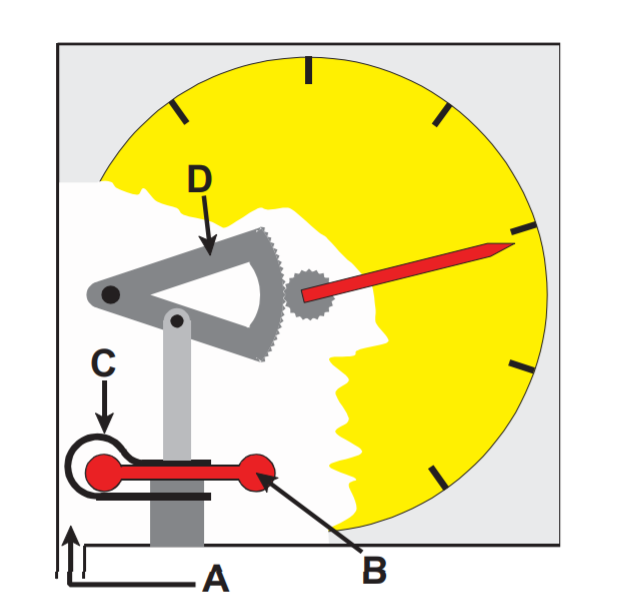
Q16. The diagram below shows a simple altimeter. The parts labelled A, B, C, and D are:
static pressure inlet, partially evacuated capsule, leaf spring, linkage mechanism
Q17. In a barometric altimeter…………. is in the capsule and …………. is fed into the case?
Vacuum_static pressure.
”
- • Capsule: The aneroid capsule is evacuated (Vacuum) to provide a fixed reference pressure.
- • Case: The instrument case is vented to the static port (Static Pressure).
- • Mechanism: The difference allows the capsule to expand/contract with altitude.
“
Q18. If the static pressure source in an un-pressurized aircraft became blocked the altimeter would…… but might be rectified by……..?
Freeze; break the VSI glass.
”
- • Blockage: Static blockage traps pressure -> Altimeter Freezes.
- • Solution: Breaking the VSI glass allows cabin air to enter the static system (since VSI/Altimeter share the line).
- • Why VSI? less critical for maintaining level flight.
“
Q19. What will happen to the altimeter indication if an aircraft in level flight enters a cold front?
Over indication.
”
- • Condition: Cold Front (Cold Air).
- • Rule: “”High to Low (Temp), Look out below.””
- • Implication: True altitude decreases. Therefore, Indicated altitude is Higher relative to True. This is an “”Over Indication””.
”
Q20. The altitude indicated on board an aircraft flying in an atmosphere where all atmosphere layers below the aircraft are warm is?
Lower than the real altitude.
”
- • Condition: Warm Air column.
- • Expansion: The air column expands. The aircraft is physically higher for a given pressure level.
- • Indication: Indicated (Pressure) < True (Real). Thus, the Indication is Lower than the Real Altitude.
”
Q21. True altitude is shown onboard (in aircraft)?
Pressure altitude.
Q22. What will happen if an aircraft has two altimeters, one of which is compensated for position error, whilst the other is not?
One will under read close to the ground.
”
- • Ground Effect: Near the ground, static pressure artificially increases.
- • Compensation: The compensated altimeter corrects for this. The uncompensated one senses the higher pressure.
- • Result: Higher Pressure = Lower Altitude. The uncompensated unit under-reads.
“
Q23. In a banked turn a barometric altimeter using a single static source?
Might over or under indicate, depending on the position of the static source.
”
- • Dynamic Pressure: Turning creates pressure differentials (suction/ram) around the fuselage.
- • Vent Position: If the vent is inside the turn, it reads high altitude . If away from the turn direction, it reads low Altitude.
- • Conclusion: Without knowing the vent location, the error is variable.
“
Q24. A servo altimeter is … because, it employs an electrical pick-off?
More accurate because… (it employs an electrical pick-off).
”
- • Technology: Servo altimeters use electromagnetic pick-offs instead of mechanical linkages.
- • Benefit: This almost eliminates friction and mechanical hysteresis.
- • Result: Higher accuracy and sensitivity.
“
Q25. The pressure altitude of the field can be found by?
Setting 1013 mb on the altimeter subscale.
- • Definition: Pressure Altitude is height above the Standard Datum Plane.
- • Standard Datum: 1013.25 hPa (or 29.92 inHg).
- • Action: Setting 1013- the altimeter reads Pressure Altitude.
Q26. A vibrator is sometimes fitted in an altimeter to?
Reduce instrument errors.
- • Classification: Friction is a type of Instrument Error.
- • Function: The vibrator reduces friction. due to that lag also reduces. and we can say overall instrument error decreases.
- • Conclusion: Therefore, it reduces instrument error. Option priority: reduces friction > Lag / Instrument
Q27. If QNH changes from 1013 hPa to 1022 hPa this will?
Not affect field elevation.
Q28. If icing or debris cause pressure disturbances at the static source, the effect will be?
Increased position error.
Q29. At a fixed pressure altitude an increase in temperature will?
Decrease density but increase density altitude.
Q30. Servo altimeters are more accurate because?
They employ electromagnetic pick-offs.
Q31. If an aircraft with two static ports, sideslips towards the unblocked port, the altitude indication will?
Decrease.
Q32. What will happen to the indicated altitude if an aircraft in level flight passes into a warmer air mass?
Under indicate.
Q33. If an aircraft with two static ports, yawing towards the unblocked port, the altitude indication will?
Increase.
Q34. What will happen to the altimeter reading in a right sideslip, if an aircraft has a static vent at each side of the fuselage, but the right one is blocked?
Over read.
Q35. If the static vent becomes partly blocked in descent the indications will?
Be too high when descending but correct when at constant pressure altitude.
Q36. If an aircraft is equipped with one altimeter which is compensated for position error and another altimeter which is not; and all other factors being equal:
At high speed, the non-compensated altimeter will indicate a higher altitude.
Q37. What is density altitude?
Pressure altitude corrected for ambient temperature.
Q38. Some altimeters employ vibrators in order to?
Minimise inaccuracies due to internal friction.
Q39. The errors affecting the pressure altimeter are:
instrument, position, manoeuvre induced, temperature, barometric, lag
Q40. One definition of pressure altitude is?
Altitude indication with 1013.25 hPa set.
Q41. An aircraft taking off from an airfield with QNH set on the altimeter has both static vents blocked by ice. As the aircraft climbs away the altimeter will:
read the airfield elevation
Q42. As pressure altitude increases?
Temperature decreases then remains constant.
Q43. If an aircraft with two static ports, sideslips towards the blocked port, the altitude indication will?
Increase.
Q44. When flying from low pressure to high pressure, without resetting the altimeter datum, the barometric error of an altimeter will cause the instrument to:
under-read the true altitude of the aircraft
Q45. In the International Standard Atmosphere, the mean sea level pressure is… the lapse rate of temperature… and is isothermal up to …
1013.25 hPa; $1.98^{circ}C$ per 1000 ft; 36 090 ft; 65 617 ft
Q46. At sea level, on a typical servo altimeter, the tolerance in feet from indicated must not exceed?
Plus or Minus 60 feet.
Q47. If the pressure feed line to a barometric altimeter becomes detached from the back of the instrument in flight the instrument will?
Read cabin altitude.
Q48. The primary factor which makes the servo-assisted altimeter more accurate than the simple pressure altimeter is the use of?
An induction pick-off device.
Q49. What is QNH?
Ambient pressure at msl.
Q50. What type of pressure sensor is employed in a barometric altimeter?
Aneroid capsule.
Q51. An altimeter with … set on the subscale will indicate……., but with ……. set, the altimeter will show …
1013; pressure altitude; QNH; altitude
Q52. The purpose of the vibrating device of an altimeter is to?
Reduce the effect of friction in the linkages.
Q53. Which of the following cause air density to decrease?
Increasing humidity, increasing altitude, increasing temperature.
Q54. The ADC obtains its altitude data from?
A barometric static pressure sensor similar to a servo altimeter.
Q55. What will a cabin altimeter read with QFE set?
Height AGL.
Q56. An aircraft has one altimeter set to QFE and one to QNH 1000 hPa. Field elev 300 ft. Immediately before takeoff QFE reads… other reads… If QFE altimeter set to 1013 at 3000ft, it reads…
zero; 300 ft; 3390 ft
Q57. From what is true altitude derived?
Pressure altitude.