Q1. The correct turn and slip indications when turning right on the ground are?
Needle right and ball left.
Q2. At a low bank angle, the measurement of rate-of turn actually consists in measuring the:
yaw rate of the aircraft
Q3. The needle of the Turn and Bank indicator shows:
The rate at which the aircraft is turning about the yaw axis.
Q4. What does it indicate if both the needle and ball in a turn and slip indicator move out to the right?
Turning right with too much bank.
Q5. What will be the immediate turn and slip indications when a left engine fails in climbing flight.
Needle left and ball right.
Q6. When the pointer of a rate of turn indicator shows a steady rate of turn:
the spring is providing a force which produces a precession equal to the rate of turn (in the correct direction)
Q7. For a coordinated rate 1 right turn at 250 Kts TAS, the correct AOB is Approximate?
32 degrees.
Q8. What are the essential properties of a turn indicator?
2,3. (One degree of freedom; Horizontal spin axis)
Q9. What does it indicate when the turn needle is out to the left and the ball out to the right?
Left turn with too little bank.
Q10. What angle of the bank would give a rate 1 turn at 200 Kts?
27 degrees.
Q11. When turning at constant bank angle the rate of turn is?
Determined by TAS.
Q12. The TBI shown below indicates: (Image: Needle Left / Ball Left)
a rate of turn to the left, slipping in
Q13. The ball in a serviceable slip indicator is… by… and… Indicate/s the state of slip?
Positioned; Acceleration; Does not always.
Q14. Following a left engine failure the pilot… uses rudder to arrest yaw… wings held level… Turn and slip indicator shows?
Needle central and ball central
Q15. For a coordinated rate 1 left turn at an AOB of 27 degrees, the TAS should be?
200 Kts.
Q16. If the turn and slip indicator shows needle right and ball left in a banked turn… corrective action is?
Skidding; push left pedal forward,
Q17. The gyro in a turn indicator must have…..gimbal…and……..degrees of freedom?
One; one.
Q18. The rate of turn indicator uses… which spins…
(i)a rate gyro (ii) up and away from the pilot
Q19. Calculated angle of bank is 19.5 degree to conduct a balanced rate 1 turn in an aircraft at 125 kts TAS at a mass of 55000 Kg? If the mass was decreased to 45000 Kg?
It would not affect the required AOB, but less power would be required.
Q20. If the filter of the air-driven rate of turn indicator becomes partially blocked:
the rate of turn will be more than indicated
Q21. The rate-of-turn is the:
change-of-heading rate of the aircraft
Q22. If the turn indicator needle is out to the right and the ball is out to the left, it indicates?
A right turn with too little bank.
Q23. A rate 1 turn at 120 kts requires?
20° AOB.
Q24. If the turn and slip indicator shows needle right and ball right… corrective action is?
Slipping; push right pedal forward.
Q25. If the aircraft is making a right turn with the angle of Bank 20 degree and TAS 200kts. What will be the indication of Turn and slip indicator?
A right turn with too little bank.
Q26. What corrective action is required if the ball is out to the right in a left turn?
More left bank.
Q27. If the turn and slip indicator shows needle left and ball right in a banked turn… corrective action is?
Skidding; push right pedal forward.
Q28. The rate of turn indicator is a very useful gyroscopic instrument. When used in conjunction with the attitude indicator it provides:
rate of turn about the yaw axis
Q29. The gimbal ring of a turn co-ordinator is inclined at about 30° with respect to the aircraft’s longitudinal axis in order to:
make the gyro sensitive to banking of the aircraft as well as to turning
Q30. What should a turn and slip indicator show in a right turn on the ground?
Needle right and ball left.
Q31. For a coordinated 300 Kts TAS rate 1 right turn the AOB should be?
37 degrees.
Q32. Following a left engine failure, the pilot of a multi-engine aircraft uses the rudder to oppose yaw and keep the aircraft on heading, whilst using the bank to prevent sideslip. What will the turn and slip indicator show?
Needle central and ball right.
Q33. In a slightly banked turn, the turn needle will indicate:
angular velocity about the vertical axis
Q34. How should the turn and slip indicator respond in a right turn when taxiing?
Needle right and ball left.
Q35. In a turn indicator, the measurement of rate of turn consists for:
low bank angle, in measuring the yaw rate
Q36. Rate of turn depends upon : (1) bank angle (2) aeroplane speed (3) aeroplane weight
1,2.
Q37. The turn needle indicates……………….in a slightly banked turn?
Angular velocity about the vertical axis.
Q38. The properties of a turn indicator are: 1. one degree of freedom 2. two degrees of freedom 3. two springs connected to the outer gimbal 4. spin axis in the longitudinal plane 5. spin axis parallel to the yaw axis 6. spin axis horizontal
1, & 6
Q39. When both the needle and ball of a turn and slip indicator are displaced to the right the aircraft is?
Turning right with insufficient TAS.
Q40. The radius of a turn at rate 1, and TAS 360 kt is:
2 NM
Q41. If both the ball and needle are out to the left in a turn, the ball can be centralized by?
Increasing TAS.
Q42. The gyro in a rate of turn indicator has (i)… operating speed… than the gyros used in other instruments because (ii).
a lower; a higher rigidity is not required
Q43. For a rate one turn at 150 Kts the AOB must be?
22 degree
Q44. If the turn and slip indicator shows needle left and the ball left in a banked turn, the aircraft is………and the required corrective action is….?
Slipping; push left pedal forward.
Q45. The correct indications when taxiing to the left are?
Needle left, ball right.
Q46. Rate of turn indications are:
Proportional to TAS.
Q47. A turn coordinator has… pivoted (ii)
a single gimbal ring; longitudinally
Q48. What angle of bank is required to conduct a balanced rate 1 turn in an aircraft at 125 kts TAS at a mass of 55000 Kg?
19.5 degrees.
Q49. When both the needle and ball of a turn and slip indicator are displaced to the right the aircraft is? (Duplicate ID check)
Turning right with too much bank.
Q50. In a turn at a constant angle of bank, the turn indicator reading is:
inversely proportional to the aircraft true airspeed.
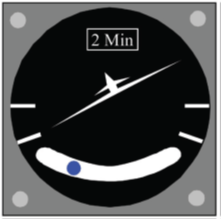
Q51. If an aircraft turns as indicated in Figure 1, below: (Needle Left, Ball Left)
the aircraft is turning left at less than 3°/second.