Results
Q1. Single DF station provides on request:
a) True/Mag bearing & heading
Q2. An aircraft is flying on heading 300°M with magnetic variation 10°W. The relative bearing of the station is 350°. Determine the QDM.
Correct answer is – 290
Q3. An aircraft is homing towards the station on track 220°T with a drift of 5° starboard. Determine the ADF reading (relative bearing).
Correct answer is – 005
Q4. What gives the greatest error in ADF:
Correct answer is – Night effect
Q5. % You are on a magnetic heading of 055 degrees, and your ADF indicates a relative bearing of 325 degrees. The QDM is?
020 degrees
Q6. An aircraft is positioned on the 080° radial from a VOR station. The aircraft heading is 090°T and magnetic variation is assumed to be zero. Determine the relative bearing of the station from the aircraft.
Correct answer is – 170
Q7. VDF is the abbreviation for:
c) VHF Direction Finder
Q8. Which of the following is likely to have the greatest effect on ADF accuracy?
Correct answer is – Interference from other NDBs, particularly at night
Q9. An ADF uses a sense aerial to:
Correct answer is – resolve ambiguous bearings
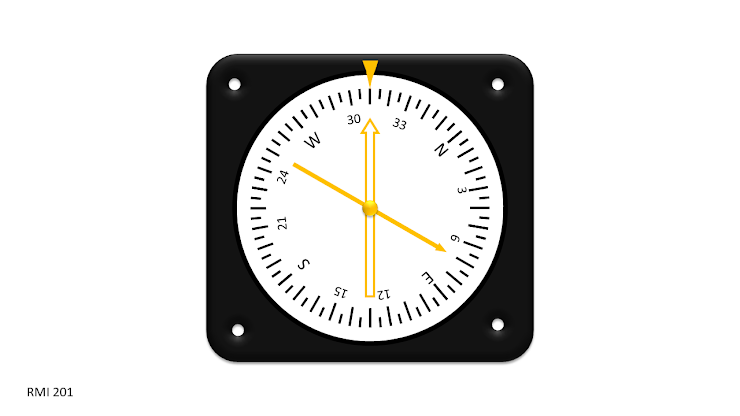
Q10. Magnetic track to NDB is.
310
Q11. VDF procedure require:
a) operator for both
Q12. What is the role of a ground DF?
a) aid pilot navigation
Q13. *Which of the following is likely to have the greatest effect on ADF accuracy?
Interference from other NDBs, particularly at night
Q14. What actually happens in the ADF receiver when the BFO position is selected?
Correct answer is – The BFO circuit imposes a tone onto the carrier wave to make the NDB’s ident audible
Q15. The magnitude of the error in position lines derived from ADF bearings that are affected by coastal refraction may be reduced by:
choosing beacons on or near the coast
Q16. The nominal maximum range of an NDB with a transmitter power of 200 watts is:
Correct answer is – 40 nm
Q17. An aircraft is homing to a station on track 020°T with a drift of 5° port. Determine the ADF reading (relative bearing).
Correct answer is – 355
Q18. # In order to resolve the 180° directional ambiguity of a directional LOOP aerial its polar diagram, is combined with that of a SENSE aerial………to produce a………whose single null ensures the ADF needle moves the shortest distance to indicate the correct…………
at the aircraft, cardioid, bearing
Q19. %*On the QDR of 075 degrees, (in the vicinity of the station) with the magnetic heading of 295 degrees, the relative bearing on the ADF indicator is.
320 degrees
Q20. #Factors liable to affect most NDB/ADF system performance and reliability include:
Static interference – night effect – absence of failure warning system
Q21. %* A VOR and an NDB are co-located. You cross the VOR radial of 240 on a heading of 360 (M). In the vicinity of the station, you should read an ADF bearing of..
60
Q22. A long range NDB is likely to transmit on ___ and be classified as ___. Select the answer to complete this statement
Correct answer is – 200 KHz; A1A
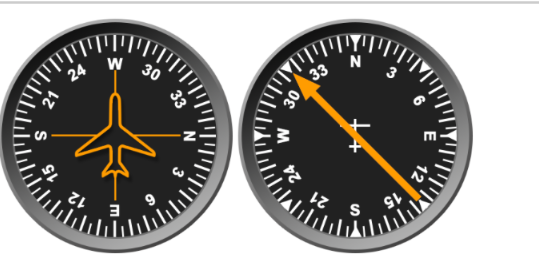
Q23. Refer to the image. What is the Magnetic Bearing (QDM) to the station?
Q24. The allocated coverage of NDBs is:
Correct answer is – 190 – 1750 KHz
Q25. When using ADF (i), the accuracy is (ii) than (iii), because the surface wave is (iv):
Correct answer is – .(i) by day; (ii) greater; (iii) by night; (iv) not present
Q26. True bearing of aircraft from station is:
d) QTE
Q27. One use of VDF service is providing:
b) homing
Q28. An aircraft is flying on heading 060°. The track to the station is 070°T. Assume zero magnetic variation. Calculate the relative bearing of the station.
Correct answer is – 10
Q29. *The phenomena of coastal refraction affecting ADF bearings is caused by the signal……. when it reaches the coastline and bending……. the normal to the coast:
accelerating; away from
Q30. What is the role of a VHF ground direction finder?
Correct answer is – To aid pilot navigation
Q31. Which of the following is correct regarding the range of an NDB?
Correct answer is – Aircraft height is not limiting for the reception of signals from the NDB
Q32. Receive signal 110 nm away (VDF 130 ft)?
c) Yes, min 6000 ft
Q33. When the induced signals from the loop and the sense antenna are combined in an ADF receiver, the resultant polar diagram is:
a cardioid
Q34. The phenomenon of coastal refraction which affects the accuracy of ADF bearings:
can be minimized by taking bearings where the signal crosses the coastline at right angles
This bending occurs because radio waves travel at different speeds over land and water due to their differing conductivities. Water, being more conductive than land, causes the radio waves to bend toward the coastline as they transition from land to sea or vice versa.
The degree of this bending depends on the angle at which the radio signal intersects the coastline. When the signal crosses the coastline at a acute angle, the bending effect is more pronounced, leading to greater inaccuracies in ADF bearings. Conversely, if the signal crosses the coastline at a right angle (perpendicularly), the change in conductivity affects the wavefront uniformly, minimizing the bending effect.
Therefore, taking bearings where the signal crosses the coastline at right angles reduces the coastal refraction, enhancing the accuracy of ADF readings.
Regarding the timing of coastal refraction effects, while some radio wave propagation phenomena are influenced by time of day—such as “night effect,” which affects ADF accuracy during dawn and dusk—coastal refraction is primarily a function of the physical properties of the terrain and is not significantly affected by the time of day.
Therefore, the statement that coastal refraction is most marked one hour before to one hour after sunrise and sunset is incorrect.
In summary, to minimize errors caused by coastal refraction in ADF bearings, it’s advisable to take bearings where the signal crosses the coastline at right angles. This approach reduces the bending effect of the radio waves, leading to more accurate navigation readings.
Q35. *In an ADF system, night effect is most pronounced:
at dusk and dawn
Q36. The maximum errors when using ADF will occur in which of the following situations: (i) Position of the NDB (ii) Angle of cut at the coast
Correct answer is – .(i) Well inland; (ii) 20°
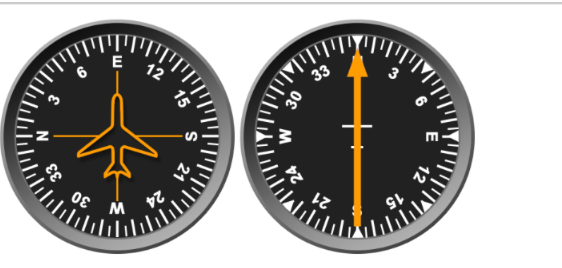
Q37. Refer to the image. What is the Magnetic Bearing (QDM) to the station?
Q38. The aircraft maintains a constant track away from the station on 130°T with a drift of 6° port. Determine the ADF reading (relative bearing).
Correct answer is – 174
Q39. An aircraft is on heading 300°. The track to the station is 305°T. Assume magnetic variation is zero. Determine the relative bearing.
Correct answer is – 005
Q40. An aircraft is flying on heading 130°T with magnetic variation 15°W. The relative bearing of the station is 348°. Calculate the QDR.
Correct answer is – 313
Q41. # Which of the following is likely to have the greatest effect on ADF accuracy?
Interference from other NDBs, particularly at night
Q42. Aircraft Hdg 090T, bearing from the station 200T. Variation at aircraft 5W, variation at station 2E. Find QDR.
Correct answer is – 198
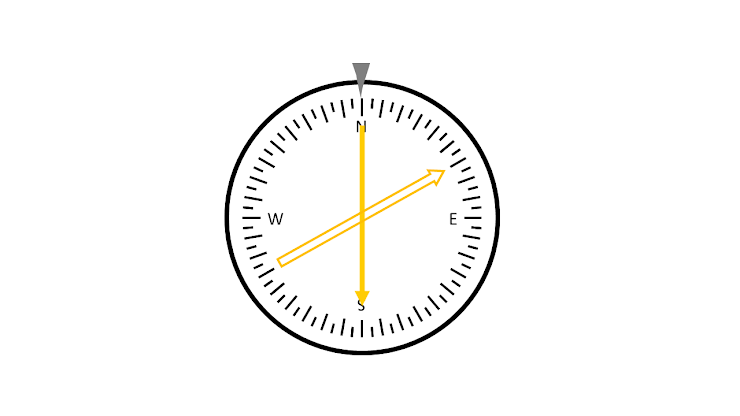
Q43. Magnetic track to NDB is.
60
Q44. Low altitude/high terrain consideration:
a) errors in bearings at station
Q45. Aircraft Hdg 130M, Relative bearing to the station is 200. Variation at aircraft 06E, variation at station 14W. Find QDM
Correct answer is – 330
Q46. *Quadrantal errors associated with aircraft Automatic Direction Finding (ADF) equipment are caused by:
Signal bending by the aircraft metallic surfaces
Q47. The ADF indication in the cockpit is a?
Relative bearing on a fixed card
Q48. ADF quadrantal error is caused by:
the aircraft’s major electrical axis, the fuselage, reflecting and re-radiating the incoming NDB transmissions
Q49. Effect of multipath signals at Ground VDF?
d) bearing errors
Q50. On which of the following displays are you able to get a direct read-out (no calculation is necessary from the pilot) of the magnetic bearing from the aircraft to the NDB?
Correct answer is – Moving card ADF and RMI
Q51. Aircraft Hdg 210M, Var at station 8E, Var at AC 6W, QTE 120, Find QDM.
Correct answer is – 306
Q52. The Automatic Direction Finder (ADF) uses the following wavelength? (You should know – ADF frequency band: 190 kHz to 1750 kHz)
Hectometric or Kilometric
Q53. An aircraft over the sea will experience (i) coastal refraction effect when the radio waves cross the coastline at (ii) and the NDB is (iii):
.(i) Less; (ii) 90°; (iii) Near the coast
Q54. Which combination gives the greatest reduction in reliability of ADF:
Correct answer is – Night effect; Static interference; Quadrantal error
Q55. What action must be taken to receive a bearing from an ADF:
Correct answer is – Both the loop and sense aerials must receive the signal
Q56. #The quadrantal error of an ADF?
Is caused by the refraction from the aircraft’s fuselage and is compensated for
Q57. An aircraft is positioned on the 080° radial from a VOR station. The aircraft heading is 090°T and magnetic variation is assumed to be zero. Determine the relative bearing of the station from the aircraft.
Correct answer is – 170
Q58. #/The BFO facility on ADF equipment should be used as follows when an NDB having NONA1A type emission is to be used:
BFO should be switched on for tuning, ident and monitoring
Q59. Which of the following is the ICAO allocated frequency band for ADF receivers?
200-1750 kHz
Q60. The purpose of the BFO switch on the ADF receiver is to:
Correct answer is – make the signal audible
Q61. A VDF may be used:
d) ATC bearings (no radar)
Q62. #In order to obtain an ADF bearing the:
Signal must be received by both the sense and loop aerials
in question they are talking about getting bearing information which is monitoring stage.
also it is not mentioned – A2A or A1A.
In A2A for monitoring BFO not required.
“”” so BFO must be on “” this answer is wrong
Q63. Which of the following is true about the ADF?
Correct answer is – It does not have a signal failure warning
Q64. What is the approved frequency band assigned to aeronautical NDBs?
Correct answer is – 190-1750 KHz
Q65. *The principal propagation path employed in an NDB/ADF system is:
surface wave
Q66. *What actually happens in the ADF receiver when the BFO position is selected?
The BFO circuit imposes a tone onto the carrier wave to make the NDB’s ident audible
Q67. %*The ADF of an aircraft on a heading of 189° (T) will experience the greatest effect due to quadrantal error if the NDB bears:
$234^{circ}(T)$
Q68. #A VOR and NDB are co-located. An aeroplane fitted with an RMI is flying away from the beacons on a radial of 090 degrees. The variation is changing rapidly. Which of the following statements is true?
The VOR needle will not move, but the ADF needle will move as the variation changes
Q69. The BFO selector switch on the ADF control panel must be in the ‘on’ position to enable the pilot to:
Correct answer is – hear the IDENT of NDBs using NON A1A transmissions
Q70. The Automatic Direction Finder (ADF) uses the following wavelength? (You should know – ADF frequency band: 190 kHz to 1750 kHz)
Hectometric or Kilometric
Q71. When considering the use of NDB, night effect has its greatest effect during:
Correct answer is – At dawn and dusk
Q72. VDF measures aircraft bearing with:
b) Ref true/mag north at station
Q73. Using an ADF loop aerial the maximum signal will be received when:
Correct answer is – The loop is PARALLEL TO ndb ( 360 OR 180)
Q74. An ADF is correctly tuned to an NDB, the needle is “hunting” and the signal is fading and growing louder alternately, the reason for this is:
Correct answer is – The required ground wave is being contaminated by sky waves
Q75. Min level at 111 NM (169ft MSL)?
b) FL60
Q76. What type of antenna(s) must be used to obtain an ADF bearing?
Correct answer is – Loop and Sense
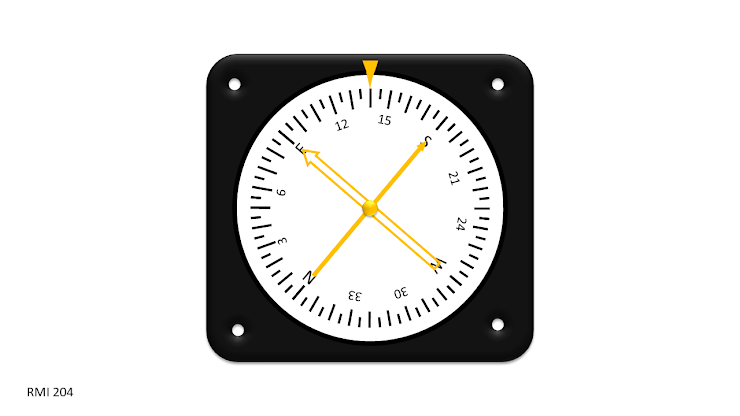
Q77. Relative bearing to the NDB is.
310
Q78. Errors caused by the effect of coastal refraction on bearings at lower altitudes are maximum when the NDB is:
Q79. Which of the following is the most significant error in ADF:
Q80. Do all ADF systems have a sense aerial:
Correct answer is – Always
Q81. # The BFO selector on an ADF receiver is used to:
Hear the IDENT of some NDB stations radiating a continuous wave signal
Q82. Range of VDF depends on (1. LOS, 2. Power, 3. Ground)?
c) 1, 2, and 3
Q83. Refer to the image Where is the station located relative to the aircraft?
Directly ahead of the aircraft. Relative bearing 000° means the station is straight ahead. Ref: Relative Bearing definition
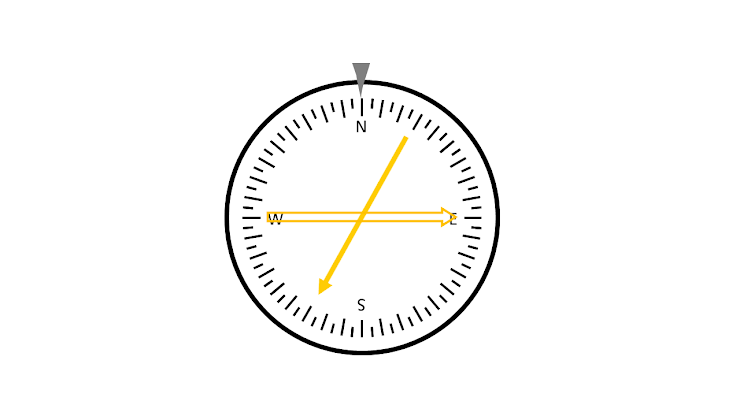
Q84. Relative bearing to the NDB is.
90
Q85. Pos in absence of radar, ATC needs:
c) Two diff locations
Q86. Aircraft Hdg 020T, Relative bearing to the station is 200. Variation at aircraft 11W, variation at station 08E. Find QTE.
Correct answer is – 040