How to Prepare for Radio Navigation for DGCA

How to Prepare for Radio Navigation for DGCA CPL and ATPL exams starts with understanding the subject as a scoring mix of theory, system understanding, and worksheet practice. DGCA’s official study-material list for CPL and ATPL includes dedicated radio navigation references, along with instrumentation references, which shows that this is a core part of exam preparation rather than an optional add-on. (Pariksha DGCA)

If you are planning your study order, Radio Navigation should be handled topic by topic. In the weightage you shared, the biggest scoring areas are VOR, ADF/NDB, worksheets on QDM/QDR, tracking and interception, and the modern navigation block covering RNAV, FMS, EFIS, and GNSS. That means the best strategy is to build from fundamentals first and then move into the higher-yield aids and worksheets.

Start with the foundation

Begin with Radio Propagation Theory. This includes radio fundamentals, propagation, antennae, and modulation. These chapters may look basic, but they are the base for everything that follows. If these four topics are weak, VDF, ADF, VOR, and radar questions become harder to understand.

A good order is:

Once these are clear, the rest of the subject becomes much easier to revise.

Move into direction finding

After the foundation, go to VDF and ADF/NDB. These are high-value topics because they train you to read bearings, interpret signals, and understand how the aircraft relates to a ground station. Your worksheets on QDM/QDR, radial bearing, tracking, RBI/RMI, and holding/intercepts are especially important because they convert theory into exam-style problem solving.

The right sequence is:

If you can solve these confidently, you already cover a strong part of the scoring zone.

Give special attention to VOR

In most DGCA prep plans, VOR is the most important Radio Navigation topic. In your weightage list, it carries the highest share, and the worksheet set around CDI, HSI, RBI, RMI, holding, and radial intercept makes it one of the most tested and repeated sections.

Focus on:

This is where many students gain or lose easy marks.

What the Community Says: Is Radio Important for DGCA on Reddit?
If you browse pilot communities to ask “is radio important for dgca?” on Reddit, the overwhelming consensus among flight students is an absolute yes. Reddit threads frequently highlight that Radio Navigation is a “make-or-break” scoring section. While some students mistake it for a pure memory subject, veteran community members consistently warn that failing to master practical worksheets (like VOR intercepts and ADF tracking) is the primary reason candidates lose easy marks under pressure.

Cover the navigation aids in order

Once VOR is strong, move to the other aids:

This order works well because it moves from classic aids to modern cockpit systems. DGCA’s official study-material list also includes radio navigation and instrument-flying references, which aligns with this kind of layered preparation. (Pariksha DGCA)

How to study for marks

For exam prep, do not read Radio Navigation like a storybook. Study it in three passes:

First, learn the concept.
Second, solve the worksheet questions.
Third, revise with timed tests.

That method helps because Radio Navigation is not only about memory. It is also about reading instruments, understanding signals, and applying the correct navigation logic under pressure.

Is Radio Navigation important for DGCA in India?

Yes. For DGCA in India, Radio Navigation is an important and highly usable subject for CPL and ATPL preparation. It is part of the official study-material ecosystem, and it appears across classic aids, radar, RNAV, and satellite navigation topics. (Pariksha DGCA)

Which is more important: Radio Navigation or Instrumentation?

For the plan you shared, Radio Navigation should get more priority than Instrumentation. Instrumentation is still important, but Radio Navigation has more high-value chapters and worksheet-based questions. A smart sequence is:

  1. Flight Planning
  2. Mass and Balance
  3. Aircraft Performance
  4. Radio Navigation
  5. General navigation
  6. Instrumentation

That order gives you the best marks per hour of study.

Final study plan

If you want a simple plan ( Study Time : 3hr daily ), follow this:

  • Week 1: Radio Propagation Theory, VDF
  • Week 2: ADF, NDB
  • Week 3: VOR and worksheets
  • Week 4: DME, ILS, Radars
  • Week 5: GPWS,RADALT,RNAV, FMS, EFIS, GNSS
  • Week 6: Full revision and mock tests

That is the cleanest way to prepare for Radio Navigation for DGCA without wasting time.


Q1: Is radio important for DGCA in India?

Answer: Yes. For DGCA in India, Radio Navigation is a highly critical, high-yield subject required for both Commercial Pilot License (CPL) and Airline Transport Pilot License (ATPL) written theory exams. It forms a substantial pillar of the official pilot training ecosystem and is heavily tested across classic ground-based aids, radar systems, and modern satellite-based navigation.

Q2: How to prepare for DGCA exam after 12th?

Answer: To prepare for the DGCA exam after 12th standard, the best approach is to break down the vast official syllabus into isolated, manageable blocks. For the technical papers: * Step 1: Start with foundational radio wave propagation theory. * Step 2: Progress into direction-finding systems (VDF, ADF, NDB). * Step 3: Master the high-yield tracking instruments (VOR, DME, ILS) using active worksheet drilling. * Step 4: Finish with advanced automated flight decks (RNAV, EFIS, FMS, GNSS). Consistently supplementing technical notes with timed mock test papers will ensure you pass on your first attempt.

Q3: How many times DGCA exams are conducted in a year?

Answer: The DGCA publishes its official, annual examination schedule directly on the central Pariksha portal ( see here), and the exact number of sessions varies dynamically depending on the calendar year and exam category. In the standard annual programme, the DGCA outlines multiple main sessions spread across the year. Furthermore, specific testing streams—such as the Foreign Aircrew Temporary Authorization (FATA) exams—are conducted twice a month, once every fortnight. Because exact dates are tentative, candidates should regularly check the portal’s digital notice board for timeline updates.

What Should Be Studied Before Instrumentation?

Before concentrating heavily on Instrumentation, students should prioritize the higher-weightage sections of Air Navigation.

These include:

  • Flight Planning
  • Fuel Planning
  • Point of No Return (PNR)
  • Equal Time Point (ETP)
  • Mass and Balance
  • Payload Calculation
  • Fuel and Load Definitions
  • Effect of CG on Aircraft Performance
  • Aircraft Performance
  • Declared Distances
  • V Speeds
  • Radio Navigation aids (VOR and NDB)
  • RADAR

Flight Planning, Performance and Mass& Balance, contribute a significant portion (30 marks) in the DGCA examination and should form the foundation of every study plan.

Which Instrumentation Topics Are Most Important?

Based on memory-based DGCA question trends, the following topics deserve the highest priority.

High-Weightage Topics

  • Altimeter
  • Mach Meter
  • DRC
  • Airspeed Indicator (ASI)
  • Gyroscope Fundamentals

These chapters consistently produce multiple questions and should be mastered thoroughly.

Frequently Tested Topics

  • Pitot Static System
  • Air Temperature Measurement
  • Vertical Speed Indicator (VSI)
  • Artificial Horizon
  • Directional Gyro Indicator (DGI)
  • Turn and Slip Indicator
  • INS / IRS

Short but Important Topics

  • Air Data Computer (ADC)
  • Earth Magnetism and Aircraft Magnetism
  • Remote Indicating Magnetic Compass

These topics may contribute only one or two questions, but they are often straightforward scoring opportunities.

Why Are Gyroscopic Instruments Important?

The Gyroscopic Instrument section is one of the most important parts of DGCA Instrumentation.

Students should have a clear understanding of:

  • Principles of Gyroscopic Rigidity
  • Precession
  • Directional Gyro
  • Artificial Horizon
  • Turn and Slip Indicator
  • Gyro Errors
  • INS and IRS Concepts

Questions from these areas frequently appear in memory-based question banks and often test conceptual understanding rather than rote memorization.

Recommended Study Strategy

A practical study sequence for DGCA CPL candidates would be:

  1. Flight Planning
  2. Mass and Balance
  3. Aircraft Performance
  4. Radio Navigation
  5. General Nvigation
  6. Instrumentation

Once the high-weightage chapters are completed, Instrumentation becomes an excellent scoring section that can help improve overall exam performance.

Final Verdict

Instrumentation is important for DGCA CPL examinations and should not be ignored. However, students should approach it strategically. High-weightage topics such as Flight Planning, Performance, Mass and Balance, and Radio Navigation should be completed first.

After building a strong foundation in these areas, focus on Instrumentation topics such as Altimeters, Airspeed Indicators, Gyroscopic Instruments, Magnetic Compass Systems.

A balanced preparation strategy will maximize scoring opportunities and improve overall performance in the DGCA Air Navigation examination.

Is Radio More Important Than Instrument for DGCA Exam? The Smart Pilot’s Strategy Guide

For student pilots plotting their path through ground school, optimizing study hours is the difference between an immediate pass and months of frustrating retakes. A common source of confusion in the Air Navigation syllabus is determining where to focus your energy: Is radio more important than instrument for DGCA exam preparation?

The short answer is yes. While Instrumentation is a crucial core competency for safe instrument flight rules (IFR) operations, Radio Navigation contains a significantly larger volume of high-yield chapters, specialized tracking worksheets, and complex navigation logic. Candidates can typically expect approximately 10 to 15 marks from instrumentation-related topics, whereas Radio Navigation—when paired with modern glass cockpit architectures—commands a much larger share of the testing matrix.

Many students make the critical error of spending excessive time memorizing structural instrument diagrams while neglecting high-scoring mathematical zones. To maximize your marks per hour of study, you must approach both modules strategically.

Radio Navigation vs. Instrumentation: Understanding the Weightage Split

When evaluating if is radio more important than instrument for dgca exam in india, it helps to review recent testing history. Looking back at question banks up through is radio more important than instrument for DGCA exam 2022 and beyond, the DGCA consistently rewards structural concept clarity and calculation accuracy over simple rote learning.

Radio Navigation contains heavy, interactive problem-solving modules. Worksheets focusing on VOR intercepts, ADF relative bearings, tracking calculations, and flight deck instrument interpretations (like the HSI and CDI) mean that a single concept can yield a massive cluster of questions.

Conversely, Instrumentation questions frequently skew toward memory-based or theoretical system vulnerabilities (such as pitot-static blockages or gyroscopic drift limitations). While these marks are highly attainable, they do not offer the same multi-question compounding value that a strong grasp of radio navigation aids provides.

What the Community Says: Debating the Syllabus on Quora and Reddit

If you look up whether is radio more important than instrument for dgca exam quora threads or search is radio more important than instrument for dgca exam reddit communities, the consensus among commercial pilot license (CPL) and airline transport pilot license (ATPL) candidates is unanimous: Prioritize Radio Navigation.

Veteran pilots on Reddit frequently point out that the Air Navigation paper is notorious for time management traps. Students who over-index on basic cockpit instruments find themselves running out of time when faced with multi-step radio interception profiles. The consensus across flight forums highlights that while instrumentation stabilizes your baseline score, radio navigation and flight planning determine whether you clear the 70% passing threshold.

Strategic Study Hierarchy: What to Prioritize Before Instruments

Before diving deep into technical instrument systems, you must build your foundation around the highest-weightage sectors of the DGCA Air Navigation syllabus. Together, Flight Planning, Performance, and Mass & Balance contribute a definitive 30-mark block that sets the baseline for your entire score.

Follow this data-driven prioritization matrix to align your preparation with actual exam layouts:

Priority RankSyllabus ModuleCore Testing Focus AreasQuestion Type
1Flight PlanningICAO Flight Plan, Fuel Planning, Point of No Return (PNR), Equal Time Point (ETP) Calculations
2Mass and BalancePayload Calculations, Fuel/Load Definitions, CG Effects on PerformanceMathematical / Formulaic / theory
3Aircraft PerformanceDeclared Distances, V-Speeds (eg. VMCG, V1, VS, VMCA, VR, VLOF, V2), Climb ProfilesTheory
4Radio NavigationVOR, NDB, ADF, GNSS, Intercept , holding, Tracking Worksheets, RADR Theory, RADLAT , SSR , TCASConceptual & Analytical
5General NavigationEarth Theory, Great circle, Map Projections, Altitude, airspeed, Triangle of Velocities, ROD, Scale, TIME 1&2,Technical Geography
6InstrumentationPitot-Static Systems, Altimeter , ASI, Mach Meter, Magnetism , DRC, Gyroscopes, Remote indicating Magnetic Compasses, INS IRSSystem Architecture & Errors

High-Yield Instrumentation Topics for Strategic Scoring

Once your high-weightage math sections are secure, Instrumentation serves as an excellent finishing module to solidify your score. To pass efficiently, classify the instrumentation chapters by historical question frequency:

1. High-Weightage Chapters

These core chapters regularly generate multiple questions and require deep structural comprehension:

  • Altimeter: Static pressure conversions, sub-scale settings (QNH, QFE, QNE), and temperature errors.
  • Airspeed Indicator (ASI): Pitot-static pressure inputs, errors, and critical cockpit markings.
  • Mach Meter: Ratios of True Airspeed (TAS) to the local speed of sound. relations b
  • Direct Reading Compass (DRC): Magnetic alignment and structural mechanics.
  • Gyroscope Fundamentals: Rigidity in space and precession mechanics.

2. Frequently Tested Systems

  • Pitot-Static System Architecture: Identifying lines, vents, drains, and blockage profiles.
  • Vertical Speed Indicator (VSl): Metering units and lag corrections.
  • Flight Deck Displays: Artificial Horizons, Directional Gyro Indicators (DGI), and Turn & Slip Indicators.
  • Inertial Reference Systems: Core principles of INS and IRS platforms.

3. Short But Straightforward Topics

These focus areas contribute only one or two questions per session but represent highly reliable scoring opportunities:

  • Air Data Computer (ADC): Centralizing air data inputs for electronic flight decks.
  • Magnetic Realities: Terrestrial magnetism variations and localized aircraft magnetism deviations.
  • Remote Indicating Compasses: Flux valve positions and electronic synchronization.

Why Gyroscopic Instruments Demand Special Attention

Within the instrumentation syllabus block, gyroscopic instruments represent the most conceptually dense territory. The DGCA frequently frames questions around these systems to test active operational visualization rather than memorized definitions.

Ensure you can confidently explain:

  • The mechanical differences between the principles of Gyroscopic Rigidity and Precession.
  • Real drift, apparent drift, and transport precession errors within the Directional Gyro.
  • Acceleration and turning errors affecting the Artificial Horizon.
  • The distinct structural functions of the Turn and Slip Indicator versus the modern Turn Coordinator.

The Reality Check: Are DGCA Exams Tougher Than Academic Entrance Tests?

As aviation in India expands, a common query among young aspirants is evaluating the overall difficulty of the path: is dgca exam tough than neet?

Comparing these fields directly is difficult because they evaluate completely different cognitive skill sets:

  • The NEET Blueprint: Evaluates high-volume academic memorization, competitive speed, and biological/chemical theory retention across millions of candidates.
  • The DGCA Blueprint: Functions as a professional certification system rather than a ranking filter. The syllabus isn’t notoriously massive, but the margin for error is thin. A simple calculation slip, a misplaced wind vector, or a misread instrument sub-scale converts an entire answer block into a failed attempt.

So, is dgca exam easy? No. While it does not require complex medical school raw memory, stating that dgca exams are easy oversimplifies the technical precision needed. When students ask why is dgca exams tough or look up forum warnings that dgca exams are hard, it is typically because candidates treat them like traditional college theory tests. The pilot exams are strict, requiring a 70% mark to pass, and demand that you think like a professional flight crew member from day one. If you maintain discipline, execute active worksheet practice, and respect the concepts, clearing these papers becomes entirely manageable.

Q1: Is a PDF study guide alone sufficient to learn if radio is more important than instrument for the DGCA exam?

Answer: While downloading an official is radio more important than instrument for dgca exam pdf or reviewing previous years’ question banks provides an excellent structural overview of the syllabus, a PDF alone is rarely sufficient. Radio Navigation requires active tracking worksheet drills, mental visualization of VOR/ADF radials, and flight computer practice. You must pair your reference documentation with step-by-step problem-solving practice to pass under real testing center time constraints.

Q2: Why do instructors recommend studying Radio Navigation before Instrumentation?

Answer: Instructors prioritize Radio Navigation because it commands higher numerical weightage on the Air Navigation paper and features highly repetitive, worksheet-based question sets. Mastering radio aids first allows you to secure core calculation marks early. This makes the descriptive, system-based study of cockpit instrumentation much easier to integrate into your weekly revision rotations.

Q3: What is the single most common mistake student pilots make during DGCA Instrumentation prep?

Answer: The most common mistake is attempting to memorize instrument indicators through rote learning instead of understanding system inputs and error mechanics. For instance, instead of memorizing the final indications of a blocked pitot tube, students should trace how static and dynamic pressures physically balance inside the casing. This conceptual approach allows you to solve any unique operational scenario an examiner presents.

Piper Seneca III PA-34 220T

Training Handout : Comprehensive Q&A Bank

Welcome to the ultimate Piper Seneca III PA-34 220T training handout and comprehensive question bank. This syllabus-aligned study guide features 80+ detailed technical questions and answers meticulously drafted for student pilots, commercial pilot license (CPL) candidates, and aviation professionals preparing for their institutional or DGCA technical general examinations. Use these structured notes to master critical limitations, aircraft systems, and operational procedures with absolute confidence.

Q1: The correct statement about Combustion Heater is:-
A: In the event of Combustion Heater overheat, the fuel, air and ignition to the Heater is automatically cut off.

Q2: What are the engine controls?
A: Throttle lever, Mixture control lever and Propeller control lever

Q3: The vacuum system is:
A: One vacuum pump for each engine, plumbing and regulating equipment.

Q4: What is the one engine inoperative best rate of climb speed?
A: 92 KTS (called VYSE)

Q5: The speed at which maximum height is gained for a given distance travelled is called:-
A: Best angle of climb speed(VX).

Q6: What is used for moving the propeller from un-feather (fine) to feather (coarse)?
A: Nitrogen

Q7: When does stall warning sound?
A: 5 to 10 knots before the actual stall and mild airframe buffeting and gentle pitching may precede the stall.

Q8: The design maneuvering speed is:
A: 140 KIAS and it decreases with lighter weight of the aircraft.

Q9: In case of engine failure during take-off, speed more than 85 KTS and there is insufficient runway to stop, the pilot should:-
A: Maintain directional control, close throttle immediately, land if airborne, stop straight ahead, and apply brakes as required.

Q10: Which of the following is incorrect?
A: The propeller can be feathered only while engine is rotating above 600 RPM.

Q11: The normal CHT range is:
A: 240° to 460° F

Q12: What happens by pulling the emergency gear extension knob?
A: Releases hydraulic pressure.

Q13: The Fuel selector during single engine operations should be:-
A: Selector for operating engine: X-FEED Selector for inoperative engine: OFF

Q14: The type of engine is:-
A: Six cylinders, direct drive, horizontally opposed, air cooled

Q15: Normal take-off procedure is:
A: RPM 2800 before releasing brakes that is less than full throttle, 40″of Hg ΜΑΡ.

Q16: What is the usable fuel tank capacity of the standard tank?
A: 93 US Gallons

Q17: Yellow arc signifies:-
A: Caution range of speed (may be used in smooth air only)

Q18: How is alternate air obtained for engine?
A: Automatic alternate air door opens if primary air source is blocked but alternate air is unfiltered and should not be used for ground operations.

Q19: Nose landing gear extension and down locking is assisted by:
A: Aerodynamic load and springs.

Q20: The datum is:-
A: 78.4″ ahead of wing leading edge at the inboard edge of inboard fuel tank.

Q21: Engine operating limits are:
A: 40″ Hg MAP/2800 RPM/220 BHP for 5 minutes.

Q22: The one engine inoperative air minimum control speed (VMCA) is:
A: 66 KIAS

Q23: The corrected noise level with two blade-propeller and with three blade-propeller respectively is:-
A: 71.4 dB(A) and 74.2 dB(A)

Q24: The landing gear is held in retracted position by:-
A: Hydraulic pressure

Q25: How is the aircraft towed?
A: Towing can be done using nose wheel steering bar which is stowed in the baggage compartment or by power equipment that will not damage or excessively strain the nose gear steering assembly. Do not tow aeroplane when controls are secured.

Q26: Action in case of engine failure during take-off when speed is 82 KTS and insufficient runway available to stop:
A: Close throttle immediately, apply maximum brakes, switch off battery, switch off fuel selector and continue straight ahead to stop.

Q27: Maximum drop allowed during feathering check is:
A: 300 RPM.

Q28: The main gear tyre pressure is:
A: 55 PSI

Q29: Continuous ground operation limitation above 32″ of Hg is:
A: Between 2000 and 2200 RPM avoid continuous ground operation (for 2 blade propeller only) above manifold pressure 32″ of Hg.

Q30: Lower red radial line signifies:-
A: One engine inoperative air minimum control speed (VMCA) and it is 66 KIAS

Q31: Nose landing gear is steerable:
A: 27° either side of centre.

Q32: Auxiliary fuel pump is provided to:
A: Supply fuel in case of failure of engine driven pump and for vapour suppression.

Q33: The engine prime time is:-
A: 3 seconds and it varies according to ambient temperature

Q34: Upper red radial line signifies:-
A: Never exceed speed (VNE) 205 KIAS

Q35: What is the type of alternator?
A: 2 x 28 Volt 60 Amperes

Q36: What will happen to landing gear in case of hydraulic failure?
A: Landing gear will free fall.

Q37: The power loading is:
A: 10.8 Lbs/ HP

Q38: What is the one engine inoperative air minimum control speed?
A: 66 KTS (called VMCA)

Q39: The type of brake system used is:-
A: Separate hydraulic reservoir, 2 single disc, double puck brake assemblies, one on each main gear.

Q40: Maximum landing weight is:-
A: 4513 Lbs.

Q41: Can the alternate air be used on ground?
A: Alternate air should not be used on ground.

Q42: The maximum landing gear extended speed (VLE) is:
A: 130 KIAS

Q43: What type of trim tab is provided in the stabilator?
A: The stabilator incorporates an anti-servo tab that moves in the same direction as the stabilator.

Q44: Yellow arc on tachometer indicates:
A: 2600 to 2800 RPM (take-off RPM for 5 minutes).

Q45: What is the type of battery?
A: 24 Volt, 65 Amp (19 AH)

/ Q46: Ground check of pitot heat must be limited to:-
A: 3 minutes.

Q47: The maximum take-off RPM is:
A: 2800 RPM for 5 minutes

/ Q48: Oil viscosity recommended is:-
A: Below 40° F: 1065 (Aviation grade), SAE 30 Above 40° F: 1100 (Aviation grade), SAE 50

Q49: Action to be taken in case of propeller over speed (caused by propeller governor malfunction) which allows the propeller blades to rotate at full low pitch is:
A: Reduce throttle, propeller to full decrease RPM(do not feather), check for control availability, reduce airspeed and throttle to maintain 2600 RPM.

Q50: How to execute manual extension of landing gear in flight?
A: Maintain speed below 85 KIAS, landing gear selector switch to gear down and pull the emergency gear extension knob.

Q51: What is the altitude limit for operation of Combustion Heater?
A: Operation of Combustion Heater above 25000 feet is not approved.

Q52: Oxygen system malfunction is indicated by:
A: Red pellets are visible.

Q53: The centre of gravity (rearward) limit for 3400 Kg is:
A: 94.6″

Q54: The type of stall warning is:-
A: Continuous horn. It is different from the landing gear warning horn which beeps at 90 cycles/second

Q55: The maximum flaps extended speed (VFE) is:
A: 115 KIAS

Q56: What is the feathering procedure:
A: Throttle-retard to verify, propeller- feather at more than 800 RPM, mixture- idle cutoff, cowl flaps- close, alternator- off, fuel selector- off, electrical load- reduce and cross feed- as required.

Q57: Action in case of engine failure in flight when speed is below 66 KTS:
A: Apply rudder towards operative engine to maintain directional control and throttle should be retarded to stop yaw forces produced by inoperative engine.

Q58: From which drain point is contaminated fuel drained?
A: The drains in each gascolator, the cross feed drains and fuel quick drains.

Q59: when does LO BUS voltage annunciator illuminate?
A: Any time total BUS voltage falls below approximately 25 volt DC.

Q60: In the event of propeller over speed, a pilot should:
A: Retard throttle to full aft and also move the propeller control to full decrease RPM

Q61: Blue radial line signifies:-
A: One engine inoperative best rate of climb speed (VYSE) 92 KIAS.

Q62: Relationship of prime time and ambient temperature is:
A: Prime time increases if ambient temperature decreases.

Q63: The maximum structural cruising speed (VNO) is:
A: 166 KIAS

Q64: Basic empty weight is:
A: The standard empty weight plus optional equipment. In other words the basic empty weight is the aircraft weight plus unusable fuel plus full oil plus unusable fluids

Q65: When will the landing gear warning sound?
A: At low throttle setting when gear is not down and locked.

Q66: How many Fuel Tank Vents are provided?
A: Two Fuel Tank Vents one under each wing.

Q67: If both suction pumps fail:-
A: Artificial horizon and directional gyro will not work, turn indicator will work and de-icing boots will not work.

Q68: What should be the immediate action to recover from an unintentional spin?
A: Retard throttle to idle, apply full opposite rudder, control wheel forward and aileron neutral.

Q69: How is the magnetic drop carried out:-
A: At 2000 RPM, maximum drop 150 RPM, maximum difference 50 RPM

Q70: What is the propeller setting on final?
A: Full forward for a possible go around.

Q71: The maximum landing gear operating speed (VLO) is:
A: Extension:130 KIAS, Retraction: 108 KIAS

Q72: Propeller setting for taxi is:
A: High RPM low pitch.

Q73: Hydraulic pressure for the landing gear is provided by:-
A: Electrically powered, reversible hydraulic pump.

Q74: Flap position for short-field take-off is:
A: 25°.

Q75: The propeller type is:-
A: Three blade, constant speed, hydraulically activated, controllable pitch and full feathering Mc Cauley, directly connected to crank shaft.

Q76: The nose gear tyre pressure is:
A: 40 PSI

/ Q77: Continuous ground operation limitation in X-wind and tail wind over 10 KTS is:
A: Between 1700 and 2100 RPM avoid continuous ground operation in X-wind and tail wind over 10 KTS.

Q78: The type of air filter used is:-
A: Paper element type.

Q79: What is the total fuel tank capacity of the standard tank?
A: 98 US Gallons

Q80: Shimming of nose landing gear is prevented by:-
A: Centering spring.

Q81: Minimum steady flight speed at which aeroplane is controllable in landing configuration is called:-
A: Stall speed VSO.

Q82: The starter cranking is limited to:-
A: 30 seconds.

Q83: Emergency gear extension is aided by:
A: Aerodynamic forces and springs.

Q84: One engine failure can be identified by:
A: Loss of thrust and yawing towards inoperative engine.

Q85: The normal EGT range is:
A: 1200° to 1525° F

Q86: The never exceed speed (VNE) is:
A: 205 KIAS

Q87: What is used for moving the propeller from feather (coarse) to un-feather (fine)?
A: Oil pressure

Q88: The purpose of Squat Switch in landing gear is:-
A: To prevent gear retraction on ground. It is located in left main gear.

Q89: The wing loading is:-
A: 22.8 Lbs/Sq Ft

Question: What are the engine operational limitations for a Piper Seneca III PA-34 220T?

Answer: The engine operating limits are 40 inches of mercury (Hg) Manifold Air Pressure (MAP), 2800 RPM, and 220 BHP. These maximum take-off power parameters are limited to a continuous duration of 5 minutes.

Question: What is the safe single-engine best rate of climb speed (VYSE) for the Seneca III?

Answer: The one engine inoperative best rate of climb speed is 92 KTS (92 KIAS). This critical single-engine target velocity is indicated visually by the blue radial line on the aircraft’s airspeed indicator.

Question: What is the single-engine air minimum control speed (VMCA) for the Piper PA-34 220T?

Answer: The one engine inoperative air minimum control speed is 66 KTS (66 KIAS). On the airspeed indicator face, this lower limitations profile is designated by the lower red radial line.

Question: How does a pilot execute the emergency manual landing gear extension procedure?

Answer: To perform manual expansion in flight, the airspeed must be restricted below 85 KIAS. Place the landing gear selector switch to the gear down position, then pull the emergency gear extension knob. This actions checklist releases internal system hydraulic pressure, allowing the main and nose gear assemblies to free fall using gravity, aerodynamic loads, and mechanical assist springs.

Question: What is the normal Cylinder Head Temperature (CHT) operating scale for this aircraft?

Answer: The normal cylinder head temperature range for stable powerplant performance spans from a minimum index of 240 degrees Fahrenheit to a maximum limit of 460 degrees Fahrenheit.

Question: What pressure systems govern the pitch modification and feathering of the propellers?

Answer: Compressed nitrogen gas is used to drive the propeller assembly from un-feathered (fine pitch) to the feathered position (coarse pitch). Conversely, engine driven oil pressure is supplied to force the propeller mechanism from feathered back to un-feathered conditions.

Question: What is the correct fuel selector valve layout during single-engine operations?

Answer: In the event of an emergency powerplant shutdown, the fuel selector control for the operating engine must be switched into the cross-feed position (X-FEED). The fuel selector configuration for the inoperative engine must be completely turned OFF.

Question: What are the exact tire pressure requirements for the main and nose gear assemblies?

Answer: Proper ground maintenance specifications require that the main landing gear tires be serviced to a pressure of 55 PSI. The steerable nose landing gear tire must be serviced to a pressure of 40 PSI.

Question: Where is the safety squat switch located and what is its operational function?

Answer: The landing gear safety squat switch is installed directly inside the left main landing gear mechanics. Its protective design purpose is to prevent an accidental, structural landing gear retraction cycle while the aircraft weight is resting on the runway during ground operations.

Question: What is the absolute structural altitude ceiling limit for the cabin combustion heater?

Answer: The operational ceiling envelope for safe deployment of the cockpit combustion heater dictates that its use is strictly not approved at any flight levels above 25,000 feet altitude.

Most Important PA-34-220T Seneca III Questions for DGCA Technical Specific Examination

1. Introduction

For CPL, IR, and Multi-Engine candidates, the DGCA Technical Specific Exam is a critical hurdle in flight training. Success in this exam proves to examiners that you have a comprehensive understanding of the aircraft’s systems, limitations, and emergency procedures.

When conducting your PA34 DGCA Preparation, you will find that specific numbers and operational limitations are frequently tested. Memorizing these exact figures for the Piper PA-34-220T is essential because they are the foundation for safe multi-engine flying and represent a large percentage of the technical specific examination questions. This guide covers the highest-yield PA34-220T Important Questions to help you focus your study efforts.

2. Most Frequently Asked Airspeed Questions

Airspeeds are some of the most heavily tested items in both written and PA34 Oral Questions. Examiners want to ensure you know your multi-engine V-speeds by heart. The sequence of 66, 82, 92, 129, 169, 205 KIAS covers a large percentage of technical-specific examination questions on the PA-34-220T Seneca III.

AirspeedValue (KIAS)Meaning & Operational Importance
VMC66Minimum control speed with one engine inoperative (OEI). Below this, the rudder becomes ineffective.
VSSE82Safe intentional single-engine speed. Used as the minimum safe speed for simulated engine failures.
VYSE92Best single-engine rate of climb. Identified by the blue radial line on the airspeed indicator.
VLE129Maximum landing gear extended speed.
VNO169Maximum structural cruising speed.
VNE205Never exceed speed, marked by the upper red radial line.

3. Weight and Balance Questions

Weight and balance limits are strictly enforced by the DGCA. You must know the exact weights and CG locations for the PA-34-220T. It is highly tested that the rear CG limit remains constant, while the forward limit changes depending on the aircraft’s weight.

Weight & Balance ItemSpecified Limit
Maximum Takeoff Weight (MTOW)4407 lb (1999 kg)
Baggage Compartment LimitsForward: 100 lb, Aft: 100 lb
Rear CG Limit94.6 in (remains constant)
Forward CG Limit (at MTOW)88.0 in at 4407 lb
Datum Location78.4 in ahead of the wing leading edge at the inboard fuel tank edge

4. Fuel System Questions

Fuel system management, especially during single-engine operations, is a core component of the Seneca III Technical Questions.

Fuel System ItemCapacity / Procedure
Standard Fuel CapacityTotal: 98 USG, Usable: 93 USG
Optional Fuel CapacityTotal: 128 USG, Usable: 123 USG
Single-Engine Fuel ManagementOperating engine fuel selector to X-FEED; Inoperative engine fuel selector to OFF

During preflight, fuel must be drained to remove water, sediment, and contamination. Fuel drains are located on each fuel tank, each fuel filter, and each crossfeed line (found on the underside of the fuselage near the trailing edge of the right wing flap).

5. Landing Gear Questions

The PA-34-220T features a hydraulically actuated retractable tricycle landing gear system. The gear is retracted and extended hydraulically, but it is locked mechanically. The retraction holding force is maintained by hydraulic pressure.

Examiners often ask about the squat switch. This switch senses weight-on-wheels to prevent accidental landing gear retraction while the aircraft is on the ground. For nose wheel steering, accomplished through rudder pedal linkage and differential braking, normal steering allows 13.5° of deflection, while maximum deflection is 27°.

6. Engine and Propeller Questions

The aircraft is powered by turbocharged, 6-cylinder, direct-drive, horizontally opposed, air-cooled Lycoming engines. Understanding how the engines and propellers operate is essential for passing your PA34 Technical Specific exam.

ComponentTechnical Specification
Maximum Continuous Power200 BHP
Propeller TypeTwo-blade Hartzell or Three-blade McCauley constant-speed feathering
Feathering System ForcesFine to Feather: Nitrogen; Feather to Fine: Oil Pressure
Maximum Cylinder Head Temp (CHT)460°F
Maximum Oil Temperature240°F (Red line)

If the primary induction air filter is blocked by ice, an automatic alternate air door opens. This alternate air is heated and unfiltered. A frequent exam limitation is that alternate air should not be used during ground operations or takeoff, as dust and debris may enter the engine.

7. Electrical System Questions

The electrical system on the Seneca III is straightforward, but the exact volt and amp figures are guaranteed to appear in the exam.

Electrical ComponentSpecification
Alternator28 V, 60 A
Battery24 V, 65 A (19 Ah capacity)

8. Frequently Asked Limitation Questions

Limitation questions are common “gotchas” in the DGCA Technical Specific Exam. Ensure you memorize these exact figures to avoid losing easy marks.

Limitation ItemRestriction
Cabin HeaterNot approved for use above 25,000 ft
Maximum Flap Extended Speed (VFE)129 KIAS
Gear Retraction Speed (VLO Retraction)111 KIAS
Starter Cranking Limit30 seconds maximum
Engine RPM RestrictionAvoid continuous operation above 32 in Hg manifold pressure between 2000–2200 RPM
Ground Wind RPM RestrictionAvoid continuous ground operation between 1700–2100 RPM when crosswind or tailwind exceeds 10 knots

9. DGCA Exam Preparation Tips

When formulating your PA34 DGCA Preparation strategy, begin by memorizing the most high-frequency numbers. Examiners love to test your immediate recall of critical V-speeds. First, lock down the sequence: 66 (VMC) -> 82 (VSSE) -> 92 (VYSE) -> 129 (VLE/VFE) -> 169 (VNO) -> 205 (VNE).

For the practical and oral elements, deeply review your single-engine memory items. In the event of an engine failure, your immediate flow must be: maintain directional control, pitch for VYSE (92 KIAS), identify the failed engine, verify the failed engine, feather the propeller if required, and secure the engine. Do not forget that intentional spins are entirely prohibited in this aircraft.

10. Conclusion

Passing the DGCA Technical Specific examination for the Piper Seneca III requires precision and exact recall of aircraft data. By focusing your study on these PA34-220T Important Questions—from multi-engine V-speeds to fuel crossfeed procedures and engine limitations—you will be well-prepared to pass your written test and oral examinations with confidence.


10 FAQ Questions and Answers

Q1: What are the most important PA34-220T airspeeds to know for the DGCA Technical Specific Exam? A: You must know the core V-speeds: VMC is 66 KIAS, VSSE is 82 KIAS, and VYSE is 92 KIAS. These are critical for multi-engine safety and are tested heavily.

Q2: What is the maximum takeoff weight (MTOW) covered in PA34 Technical Specific notes? A: The Maximum Takeoff Weight (MTOW) for the PA-34-220T Seneca III is exactly 4407 lb.

Q3: How does the landing gear system operate on the Seneca III? A: The landing gear is hydraulically actuated and retractable. It is extended and retracted hydraulically, but it is locked mechanically in the down position.

Q4: What is the cabin heater altitude limitation on the PA-34-220T? A: A very common Seneca III technical question is the heater limitation. The combustion heater is not approved for use above 25,000 feet.

Q5: What is the fuel capacity tested in PA34 DGCA preparation? A: The standard total fuel capacity is 98 USG with 93 USG usable. If equipped with optional tanks, the total capacity is 128 USG with 123 USG usable.

Q6: What is the proper fuel selector configuration for single-engine operations? A: During single-engine operations, the operating engine’s fuel selector should be set to X-FEED, while the inoperative engine’s fuel selector must be turned OFF.

Q7: What are the electrical system specifications for the PA-34-220T? A: The aircraft uses a 28 V, 60 A alternator and a 24 V, 65 A battery.

Q8: How does the propeller feathering system work on the PA34? A: The constant-speed feathering propellers use nitrogen pressure to drive the blades from fine pitch to feather, and oil pressure to move them from feather back to fine pitch.

Q9: What are the primary engine temperature limitations for the Seneca III? A: The DGCA technical specific exam will test the Maximum Cylinder Head Temperature (CHT), which is 460°F, and the Maximum Oil Temperature, which is 240°F.

Q10: Which PA34 oral questions are asked about alternate air? A: Examiners often ask when NOT to use alternate air. Because it is unfiltered, alternate air should not be used during ground operations or takeoff, as debris could enter the engine.


In aviation radiotelephony, Type C call signs are the most widely used format in commercial operations. These call signs consist of:

  • The telephony designator of the aircraft operating agency, followed by
  • The flight identification number

Typical Examples

  • SCANDINAVIAN 937
  • Fastair 345
  • AIC 111 → “Air India One One One”
  • IGO 2234 → “IndiGo Two Two Three Four”
  • SEJ 2034 → “SpiceJet Two Zero Three Four”

Standard ICAO Rule (Core Principle)

As per ICAO provisions, Type C call signs shall always be transmitted in full.

There is no provision for abbreviation.

This rule exists to:

  • Prevent call sign confusion
  • Enhance situational awareness in high-density traffic
  • Maintain standardization in global operations

Use of Alphanumeric Call Signs

With increasing traffic and call sign similarity issues, operators are now adopting alphanumeric call signs, including combinations of numbers and letters.

Example

  • HIGHJET 12BA

Correct RT Transmission

  • “HIGHJET, WUN TOO, BRAVO ALFA”

Incorrect (Not Permitted)

  • “HIGHJET BRAVO ALFA” ❌

Key Point

Even when letters are used at the end (bi-grams), the entire call sign must be transmitted, including numeric components.


Exception to the Rule – France

In practice, a notable exception exists:

In France, under a national regulatory framework:

  • Controllers may abbreviate Type C call signs
  • This applies only when the call sign ends with a two-letter bi-gram

Example

  • HIGHJET 12BA → may be shortened to HIGHJET BRAVO ALFA (France only)

Important Limitation

This exception does NOT apply to:

  • HIGHJET 3456
  • HIGHJET 345B

Operational Trend

The use of final two-letter bi-grams is increasing because:

  • It helps in call sign similarity deconfliction
  • Reduces confusion between similar numeric call signs
  • Improves identification in congested airspace

Operational Advisory (Industry Practice)

Air Navigation Service Providers (ANSPs) and aircraft operators are encouraged to:

  • Share operational practices for managing call sign confusion
  • Improve:
    • Sector and frequency management
    • Monitoring procedures
    • Flight Data Processing (FDP) and HMI track labeling
  • Ensure availability of proper R/T designators to controllers
  • Promote the use of alphanumeric call signs where appropriate

Regulatory Emphasis (ICAO Compliance)

Controllers and flight crews must be reminded that:

  • Type C call signs consist of:
    • ICAO R/T designator (not the 3-letter code), and
    • Flight identification
  • Abbreviation is not permitted, except for the France-specific case

Recommendation for Operators

Aircraft operators should:

  • Apply for an official ICAO R/T designator in accordance with ICAO Doc 8585 (if not already assigned)
  • Adopt standardized call sign formats to enhance safety and communication clarity

Final Exam-Oriented Takeaway

  • Type C = Operator + Flight Number
  • No abbreviation allowed (standard ICAO rule)
  • Exception: France (only for final two-letter bi-grams)
  • Increasing use of alphanumeric call signs for deconfliction

ATC Phrase: “Station Calling Chennai, Say Again Your Call Sign”

This phrase is used by an Air Traffic Control (ATC) station when they have received a transmission directed to them, but they are uncertain of the identification of the calling aircraft.

Breakdown of the Phrase

  • “Station calling Chennai”:
    ATC uses this phrase when they did not hear or could not understand the identity of the calling aircraft. It is a general call addressed to the unknown station.
  • “Say again your call sign”:
    The standard radiotelephony phrase SAY AGAIN means “Repeat all, or the following part, of your last transmission.” ATC is specifically requesting the pilot to repeat their call sign for proper identification.

Correct Pilot Response

If you receive this call from ATC, you should respond by stating the facility name followed by your full aircraft call sign.

Example:
“Chennai, Fastair 345”

Quick Summary (Exam-Oriented)

  • Type A → Registration-based (General Aviation)
  • Type B → Operator + partial registration
  • Type C → Operator + flight number (Airlines – most common)
  • Abbreviation Rule → Allowed in Type A & B only; not in Type C


Types of Call Signs in Aviation

In radiotelephony (RT), aircraft call signs ensure standardized and unambiguous communication between pilots and Air Traffic Control (ATC). As per ICAO provisions, call signs are classified into three types based on their structure and operational usage.


TYPE A – Registration-Based Call Signs

Characters corresponding to the registration marking of the aircraft.

Type A call signs are derived directly from the aircraft registration and are primarily used in general aviation.

Examples

Full Call Signs:

  • VT-ESC → “Victor Tango Echo Sierra Charlie”
  • CESSNA VT-KMC → “Cessna Victor Tango Kilo Mike Charlie”

Abbreviated Call Signs:

  • VT-ESC → “Echo Sierra Charlie” or “Victor Sierra Charlie”
  • CESSNA VT-KMC → “Cessna Kilo Mike Charlie”

RT Phraseology Example

  • Pilot (Initial Call):
    “Delhi Tower, Cessna VT-KMC, ready for departure.”
  • ATC Response:
    “Cessna KMC, Delhi Tower, line up runway 28.”
  • Pilot (Subsequent):
    “Line up runway 28, Cessna KMC.”

Key Point

  • First transmission → Full call sign mandatory
  • Subsequent transmissions → Abbreviation permitted

TYPE B – Operator + Registration Call Signs

Telephony designator of the operating agency followed by the last four characters of the registration.

Examples

Full Call Sign:

  • AIR INDIA VT-ESC → “Air India Victor Tango Echo Sierra Charlie”

Abbreviated Call Signs:

  • “Air India Sierra Charlie”
  • “Air India Victor Sierra Charlie”

RT Phraseology Example

  • Pilot (Initial Call):
    “Mumbai Tower, Air India VT-ESC, request taxi.”
  • ATC Response:
    “Air India VSC, taxi to holding point runway 27.”
  • Pilot:
    “Taxi to holding point runway 27, Air India VSC.”

Key Point

  • Combines operator identity + registration
  • Abbreviation allowed after initial contact

TYPE C – Operator + Flight Number Call Signs

Telephony designator of the operating agency followed by flight identification.

This is the standard format in commercial airline operations.

Examples

  • AIC 111 → “Air India One One One”
  • IGO 2234 → “IndiGo Two Two Three Four”
  • SEJ 2034 → “SpiceJet Two Zero Three Four”

RT Phraseology Example

  • Pilot:
    “Delhi Tower, Air India 111, ready for departure.”
  • ATC:
    “Air India 111, cleared for takeoff runway 28.”
  • Pilot:
    “Cleared for takeoff runway 28, Air India 111.”

Key Point

  • No abbreviation permitted
  • Used in high-density traffic environments

Quick Summary (Exam-Oriented)

  • Type A → Registration-based (General Aviation)
  • Type B → Operator + partial registration
  • Type C → Operator + flight number (Most common in airlines)
  • Abbreviation Rule → Allowed in Type A & B only, not in Type C

Practice / Exam Questions

1. Multiple Choice Questions

Q1. Which type of call sign uses only aircraft registration?
A. Type A
B. Type B
C. Type C
D. None

Answer: A


Q2. Abbreviated call signs are permitted in:
A. Type A only
B. Type B only
C. Type A and B
D. Type C

Answer: C


Q3. Which call sign is most commonly used in commercial airline operations?
A. Type A
B. Type B
C. Type C
D. All equally

Answer: C


2. Short Answer Questions

Q1. When can a pilot use an abbreviated call sign?
Answer: After initial contact, when ATC has already acknowledged the aircraft.


Q2. Why are abbreviated call signs not permitted in Type C?
Answer: To avoid confusion in high-density traffic and ensure safety.


3. Practical RT Question

Q: Convert the following into correct RT phraseology:
IGO 2234 ready for departure runway 27

Answer:
“Delhi Tower, IndiGo Two Two Three Four, ready for departure runway 27.”


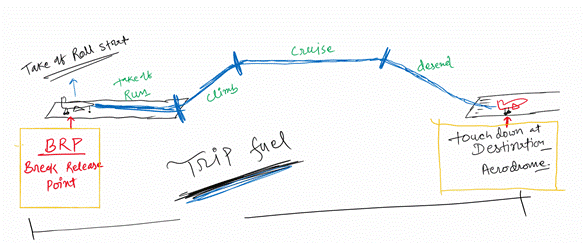
Trip fuel is the fuel required to operate the aircraft from brake release at the departure aerodrome to touchdown at the destination. It includes fuel for the entire flight profile—take-off, climb, cruise, descent, approach, and landing. This is the primary operational fuel component, calculated based on planned route, altitude, aircraft performance, and expected conditions. It does not include any reserve or contingency fuel, which are added separately for safety margins.

Trip Fuel (as per ICAO)

According to ICAO fuel planning requirements, Trip Fuel is the fuel required from take-off (brake release) to landing at the destination aerodrome under planned conditions.

Included in Trip Fuel:
  • Take-off roll
  • Climb to cruising level
  • Cruise segment
  • Descent
  • Approach procedures
  • Landing

👉 It represents the fuel to complete the planned flight profile only, without any allowances for abnormal or unforeseen conditions.


Trip Fuel (with Example)

Trip fuel is calculated based on fuel flow (fuel burn rate) and time spent in each phase of flight—climb, cruise, and descent. Each phase consumes fuel at a different rate, so total trip fuel is the sum of all phases.

Example 1:


Consider a flight with the following data:

  • Climb: 10 minutes at 40 kg/min → 400 kg
  • Cruise: 2 hours (120 min) at 25 kg/min → 3000 kg
  • Descent: 15 minutes at 15 kg/min → 225 kg

Total Trip Fuel:

Trip Fuel = 400 + 3000 + 225 = 3625 kg

👉 In this case, 3625 kg is the fuel required from take-off to landing, excluding contingency and reserves.

Example 2:


A flight is planned with a fuel flow of 80 lb/hr. Allow 3 minutes for climb with an additional 6 lb, 2 hours 37 minutes cruise, and 10 minutes descent with no correction. Calculate the Trip Fuel.

Explanation:
Convert fuel flow: 80 lb/hr ≈ 1.33 lb/min.
Climb fuel = (3 × 1.33) + 6 ≈ 10 lb.
Cruise fuel = 157 × 1.33 ≈ 209 lb.
Descent fuel = 10 × 1.33 ≈ 13 lb.

Answer:
Total Trip Fuel = 10 + 209 + 13 = 232 lb (approx).

A.10.1 BASIC RADIO THEORY

a) Electromagnetic Waves

  • Nature of electromagnetic radiation
  • Relationship between electric and magnetic fields
  • Velocity of propagation (speed of light)
  • Frequency (f), wavelength (λ), period, cycle
  • Phase and phase difference
  • Amplitude and its significance
  • Frequency spectrum and allocation
  • Frequency bands (ELF to EHF; aviation-relevant bands: LF, MF, HF, VHF, UHF, SHF)

Modulation & Signal Characteristics

  • Carrier wave concept
  • Modulation and demodulation principles
  • Amplitude Modulation (AM)
    • Modulation index
    • Advantages and limitations in aviation
  • Frequency Modulation (FM)
    • Deviation and bandwidth
    • Comparison with AM
  • Pulse modulation (basic concept)
  • Sidebands
    • Upper and Lower Sidebands
    • Double Sideband (DSB)
    • Single Sideband (SSB)
  • Bandwidth requirements
  • Designation of emission (ITU emission designators)
  • Signal-to-noise ratio (SNR) and its operational significance

b) Antennas

  • Basic antenna theory
  • Antenna characteristics
    • Gain
    • Efficiency
    • Directivity
    • Radiation pattern
  • Polarisation
    • Vertical
    • Horizontal
    • Circular
  • Polar diagrams (interpretation and use)
  • Types of antennas used in aviation
    • Dipole
    • Monopole
    • Loop
    • Directional antennas
    • Parabolic reflector

c) Wave Propagation

  • Ground waves (surface waves)
  • Direct waves (line-of-sight propagation)
  • Sky waves (ionospheric reflection)
  • Ionosphere structure and layers (D, E, F layers)
  • Critical angle and critical frequency
  • Skip distance
  • Dead space (skip zone)
  • Refraction
  • Fading (selective and multipath fading)
  • Factors affecting propagation:
    • Reflection
    • Absorption
    • Attenuation
    • Coastal refraction effects
    • Mountain effect
    • Static interference

A.10.2 AUTOMATIC DIRECTION FINDER (ADF)

a) ADF Loop Theory

  • Basic principle of direction finding
  • Loop antenna theory
    • Figure-of-eight polar diagram
    • Null position concept
  • Sense antenna function
    • Elimination of 180° ambiguity
  • Combination of loop and sense antenna

Rotating and Fixed Loop Antennas

  • Manually rotated loop systems
  • Automatic (fixed loop) ADF systems
  • Bearing determination process

Principles of Operation

  • NDB transmission characteristics
    • Frequency band (LF/MF)
    • Non-directional transmission
  • ADF receiver components
  • Bearing determination relative to aircraft heading
  • Magnetic bearing to station (QDM)
  • Magnetic bearing from station (QDR)
  • Relative bearing

Presentation and Interpretation

  • Relative bearing indication
  • Magnetic bearing interpretation
  • Homing vs tracking
  • Wind effect and drift correction
  • Station passage recognition

Coverage

  • Ground wave propagation characteristics
  • Day and night effect
  • Coastal refraction influence

Range

  • Dependence on transmitter power
  • Surface conductivity
  • Atmospheric conditions
  • Night effect range increase

Errors and Accuracy

  • Quadrantal error
  • Dip error (bank error)
  • Night effect
  • Coastal refraction
  • Mountain effect
  • Static interference
  • Electrical interference

Factors Affecting Range and Accuracy

  • Ionospheric conditions
  • Terrain
  • Thunderstorms
  • Aircraft attitude
  • Receiver calibration

RBI and RMI

  • RBI (Relative Bearing Indicator)
    • Fixed card presentation
    • Relative bearing reading only
  • RMI (Radio Magnetic Indicator)
    • Rotating compass card
    • Direct magnetic bearing display
    • Dual-needle capability (ADF/VOR integration)

A.10.3 VHF OMNI-DIRECTIONAL RANGE (VOR)

Principles of Operation

  • VHF frequency band (108.00–117.95 MHz)
  • Line-of-sight propagation
  • Reference phase and variable phase signals
  • Phase comparison principle
  • Radial concept (FROM station)
  • Bearing determination

Presentation and Interpretation

  • OBS (Omni Bearing Selector)
  • TO/FROM indication
  • Radial interception
  • Tracking procedures
  • Station passage identification

Coverage

  • Line-of-sight limitations
  • Classification of VOR stations:
    • Terminal (T-VOR)
    • Low altitude (L-VOR)
    • High altitude (H-VOR)

Range

  • Dependence on altitude
  • Service volume categories
  • Geographical limitations

Errors and Accuracy

  • Site error
  • Scalloping
  • Bends
  • Propagation error
  • Instrument error

Factors Affecting Range and Accuracy

  • Terrain shielding
  • Multipath interference
  • Atmospheric conditions
  • Aircraft altitude

CDI and RMI

CDI (Course Deviation Indicator)

  • Lateral deviation indication
  • Sensitivity (dots displacement)
  • Full-scale deflection values
  • Intercept angles

RMI (Radio Magnetic Indicator)

  • Bearing pointer operation
  • Integration with magnetic heading
  • Situational awareness enhancement

Doppler VOR

  • Principle of Doppler effect application
  • Frequency modulation simulation
  • Advantages over conventional VOR
    • Reduced site error
    • Improved accuracy
  • Identification characteristics

A.10.4 DISTANCE MEASURING EQUIPMENT (DME)

  • Principles of operation
    • Pulse interrogation and reply
    • Time delay measurement
    • Slant range concept
  • Presentation and interpretation
    • Distance display
    • Groundspeed and time-to-station (if applicable)
  • Coverage characteristics
  • Maximum and practical range
  • Errors and accuracy
    • Slant range error
    • Multipath error
  • Factors affecting range and accuracy

A.10.5 BASIC RADAR PRINCIPLES

  • Primary radar principle
  • Pulse techniques
  • Radar terminology:
    • Pulse Repetition Frequency (PRF)
    • Pulse Repetition Time (PRT)
    • Pulse length
    • Duty cycle
    • Peak and average power
    • Range resolution
    • Azimuth resolution

A.10.6 GROUND RADAR

  • Principles of operation
  • Presentation and interpretation (PPI display)
  • Coverage
  • Range determination
  • Errors and accuracy
  • Factors affecting range and accuracy
    • Ground clutter
    • Sea clutter
    • Shadowing
    • Anomalous propagation
  • Application for navigation

C.10.7 SECONDARY SURVEILLANCE RADAR (SSR)

  • Principles of operation
    • Interrogation and reply system
  • Presentation and interpretation
  • Modes and codes:
    • Mode A
    • Mode C
    • Mode S
  • Transponder operation
  • Identification features

A.10.8 AIRBORNE WEATHER RADAR

  • Principles of operation
    • Pulse radar
    • Reflectivity concept
  • Presentation and interpretation
    • Tilt control
    • Gain control
    • Colour coding
  • Coverage
  • Range limitations

A.10.9 RADIO ALTIMETER

  • Principles of operation
    • Frequency-modulated continuous wave (FMCW) principle
  • Operating frequency band
  • Presentation and interpretation
  • Errors and accuracy
    • Terrain reflectivity
    • Bank angle effects
    • Signal absorption

A.10.10 EMERGENCY LOCATOR TRANSMITTER (ELT)

  • Principles of operation
  • Operating frequencies
    • 121.5 MHz
    • 406 MHz
  • COSPAS-SARSAT system overview
  • Testing procedures and limitations

A.10.11 AREA NAVIGATION (RNAV)

VOR/DME Area Navigation

  • Principle of operation
  • Waypoint generation
  • Advantages and disadvantages
  • Accuracy
  • Reliability
  • Coverage limitations
  • Required flight deck equipment

A.10.12 SATELLITE ASSISTED NAVIGATION (GNSS / NAVSTAR GPS)

  • System components
    • Space segment
    • Control segment
    • User segment
  • Principle of operation
    • Trilateration
    • Pseudorange measurement
  • Advantages and disadvantages
  • Navigation system performance requirements
    • Accuracy
    • Integrity
    • Continuity
    • Availability
  • Reliability and integrity monitoring (RAIM concept)
  • Authorisation and documentation requirements
  • Errors and limitations
    • Satellite clock error
    • Ionospheric error
    • Multipath
    • Geometry (GDOP)
  • Human factors and GNSS
Scroll to Top